






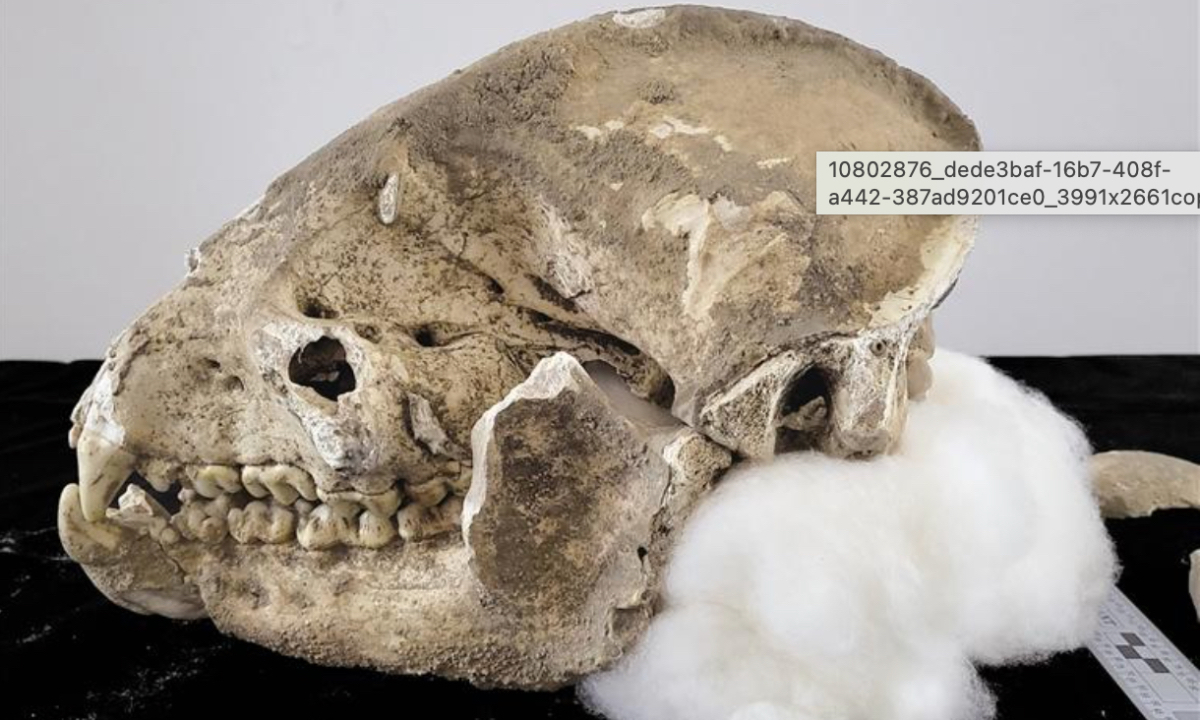
Ancient giant panda fossils were recently discovered in a limestone cave in Chenggu County, Hanzhong City, Shaanxi Province. This incredible discovery marks a major milestone for Chinese paleontology. The remains exhibit an extremely high level of preservation. The skull is intact for over 90%, while the entire skeleton is preserved for approximately 70%. This is a rarity for this species, and holds extraordinary scientific and educational value.
Ancient giant panda fossils discovered in Hanzhong: Origin and characteristics of the fossils
Experts date the remains to the Late Pleistocene period, between 200,000 and 10,000 years ago. The discovery site is approximately 180 meters deep inside the cave. The dark, humid environment is characterized by constant dripping water and an underground river, factors that favored the preservation of bone tissue and the deposition of calcium carbonate around the Pleistocene era.
Distinct remains of the humerus, femur, vertebrae, and ribs, ranging in length from a few centimeters to over 20, were found at the site. Preliminary morphological analysis attributed the fossils to an adult specimen, probably female, with a skull measuring 30.2 cm in length, 17.3 cm in width, and 21.2 cm in height.
Hypotheses on the deep discovery of fossils
According to Zeng Zhongcheng, deputy director of the Shaanxi Center for Fossil Research and Protection, it's possible the panda accidentally entered and became trapped in the cave. Or it may have fallen from a nearby waterfall and been carried by the underground river to the site where it was found.
Importance of the discovery and future studies
Hu Songmei, a member of the Shaanxi Paleontology Expert Committee, emphasized that unlike fragmentary finds from the past, this is the first time nearly complete giant panda fossils have been found in this region of China. The goal now is to reconstruct a nearly intact skeleton to further our understanding of the evolution and biology of this species.
The Shaanxi Provincial Department of Natural Resources will soon coordinate further protection, research, and advanced analysis activities. These will include radiocarbon dating and genetic studies through DNA analysis to place these remains in the historical and environmental context of Pleistocene fauna.