






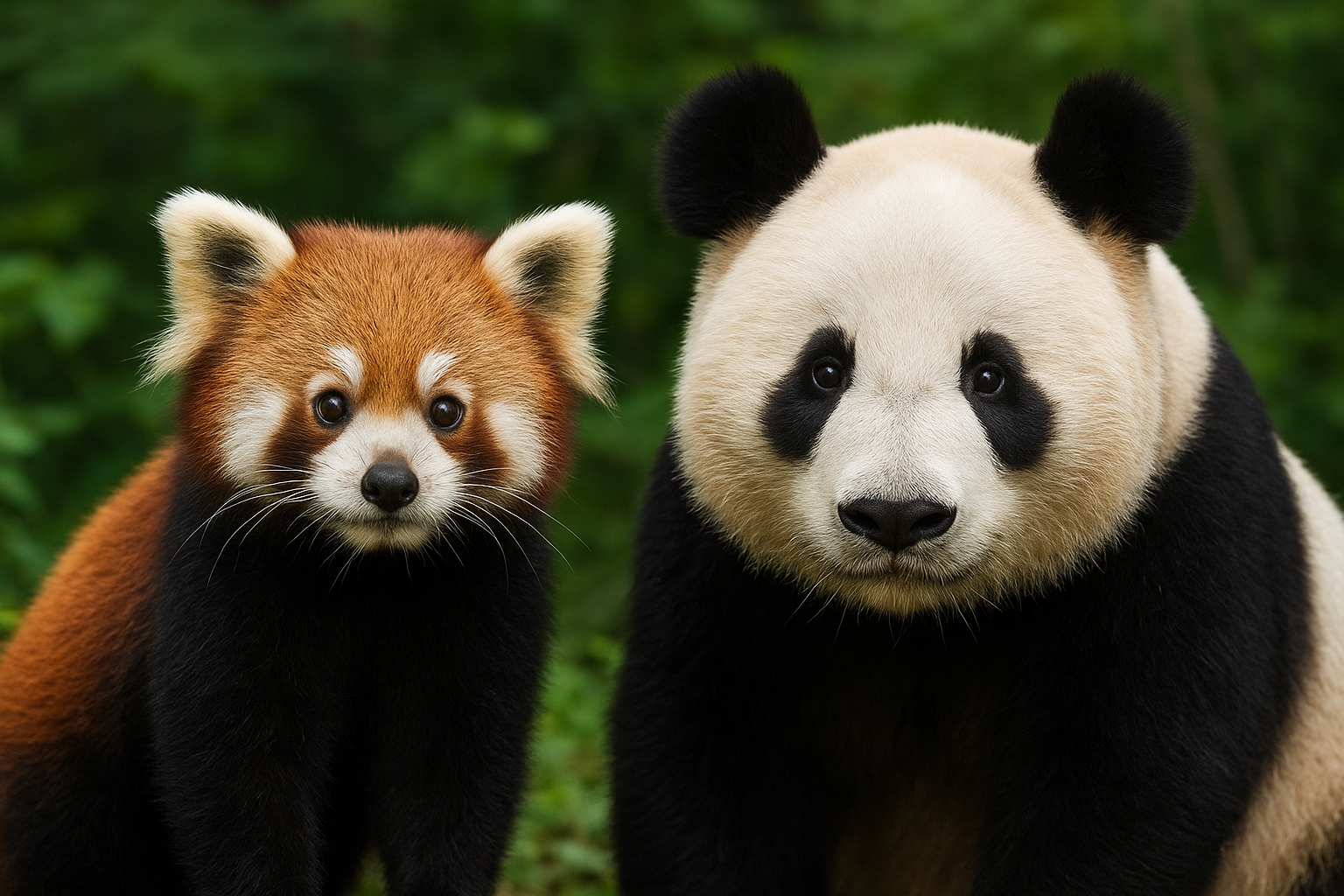
The animal world often hides fascinating paradoxes, and one of the most curious concerns precisely the panda. On one side there is the famous giant panda, a universal symbol of conservation and China; on the other hand the tender and agile red panda, which lives among the branches of the Himalayan forests. But are the two really cousins or relatives? The answer surprises even experts: Despite their name, the red panda and the giant panda are not related.. Science, in fact, tells us a story of parallel evolution, similar adaptations and a shared name only by chance.
Red panda and giant panda, cousins or homonyms: orOrigins and classification: two separate evolutionary histories
Are the red panda and the giant panda cousins? Let's clarify. giant panda belongs to the family of Bears, that of bears, together with grizzly bears, polar bears and brown bears. It is therefore, to all intents and purposes, a bear with a particular diet. red panda (Ailurus fulgens), instead, is part of a completely different family: the Ailurids, related to raccoons, weasels, and skunks. In practice, from a genetic point of view, the red panda is closer to a raccoon than to its giant namesake.
Evolution: Two Paths That Cross Only in Bamboo
Millions of years ago, a common ancestor gave rise to distinct evolutionary lines: one led to bears (from which the giant panda arose), the other to small arboreal mammals (from which the red panda arose).
Over time, both species developed a bamboo-based diet and some similar features — like the famous “false thumb”, a modified wrist bone used for grasping shoots. However, these similarities are the result of a phenomenon known as convergent evolution, not of direct kinship.
Similarities: The allure of convergent evolution
Despite their genetic distance, the two pandas share surprising similarities:
- Bamboo diet, rich but poor in nutrients.
- Similar habitats, in the mountain forests of China and the Himalayas.
- Unique physical adaptations, such as the “false thumb” and a specialized digestive system.
Even the name “panda” comes from the Nepalese term ponya, what does it mean bamboo eater. Curiously, The red panda was discovered and named before the giant panda.
You may also be interested in:
Red pandas are the stars of the Chinese New Year
Key differences between the red panda and the giant panda
| I wait | Giant Panda | Red Panda |
|---|---|---|
| Family | Ursids (bears) | Ailurids (single species) |
| Cut | Up to 150 kg | 3-6 kg |
| Habitat | Earthly, bamboo forests | Arboreal, mountain forests |
| Diet | Almost exclusively bamboo | Bamboo, fruit, eggs, insects |
| I wait | Black and white, massive | Red-brown, agile, with a bushy tail |
| Behavior | Solitary and peaceful | Active, climber and nocturnal |
Scientific curiosity: two species that are symbols of conservation
Today, both the red panda and the giant panda are protected species and ambassadors of the Asian biodiversity. Both represent the fragile balance between man and nature, threatened by deforestation and climate change.
The giant panda has become the symbol of the WWF, while the red panda is the protagonist of numerous conservation programs in Nepal, Bhutan and China. Red and giant pandas share only their names and their love of bamboo., but their genetic history separates them by millions of years. Two different evolutionary paths, united by the same destiny: to remind us how extraordinary nature is at reinventing itself.