






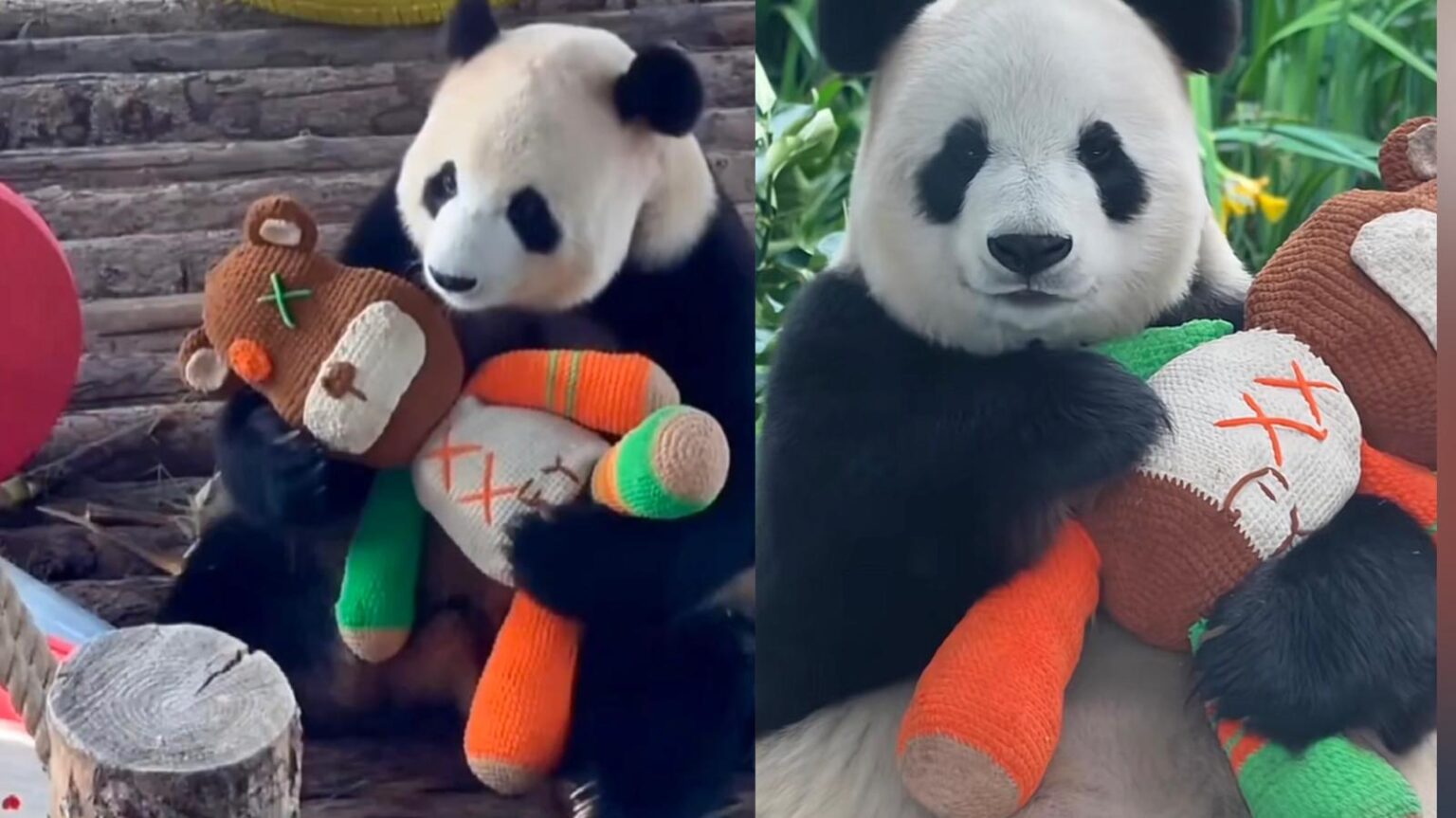
Have you ever wondered why giant pandas sleep or play with stuffed animals? In reality, that stuffed animal is almost always part of a structured environmental enrichment program. All stuffed animals, beanbags, stuffed balls, and things to grasp and shake are designed to stimulate curiosity, play, and exploration in a controlled environment. The goal is not to "humanize" the panda, but to offer something that invites it to act: sniff, bite, push, climb, roll. Each stuffed animal provides additional stimulation that breaks up the monotony, increases the variety of behaviors, and, over time, helps keep the animal more active and mentally engaged. Indeed, it becomes an integral part of the giant panda's life, almost like a best friend or a child to be cared for and protected.
The importance of stuffed animals for giant pandas: why do they need enrichment in captivity?
In the wild, a giant panda spends much of its day moving around, searching for bamboo, orienting itself in a complex environment, reacting to ever-changing smells, sounds, and weather conditions. In captivity, however, many of these variables disappear. Food arrives at specific times, space is limited, and surprises are few. It's a safer life, but often also more predictable. This predictability can lead to two problems: inactivity and stereotypies, i.e., repetitive behaviors with no apparent purpose (such as pacing back and forth along the same path).
Enrichment serves precisely to reduce "empty time" and fill it with stimuli: objects to explore, new smells, puzzles to solve, games to manipulate. Puppets fit into this framework as simple but extremely versatile tools.
What do giant panda dolls actually do?
A good enrichment program for a giant panda doesn't simply introduce a stuffed animal into the enclosure; it also involves planning the type of object, how often, and how it's presented, all while observing how the animal responds. Soft toys and stuffed balls, for example, tend to encourage physical play. The animal hugs, pushes, drags, and wrestles with the object, often rolling around with it. Other objects, perhaps filled with scents or small portions of food (puzzle feeders), encourage searching, sniffing, and problem-solving to earn a reward. The result, if everything is well designed, is a more dynamic day. More time spent actively engaged, less time spent in purposeless repetitive movements, and a richer behavioral repertoire, closer to what a panda would display in a natural environment.
Puppets, puppies and motherhood: when play meets management
The topic of soft toys becomes even more delicate when it comes to cubs. Giant panda babies are born tiny, fragile, and completely dependent on their mother. In breeding centers, especially when it comes to twins, staff must strike a balance between human intervention and respect for the mother-cub bond. In some situations, soft objects can be used as support in handling procedures, to facilitate exchanges between cubs, to make care procedures easier, or to improve safety during handling. However, the central point remains the same. The mother-cub bond is the focus, and every object introduced—including soft toys—must support this bond, not replace it.
How do you design a good “toy” for a giant panda?
Not all puppets work the same way. To design a good giant panda enrichment object, you need to consider a few key elements:
- Materials: must be safe, durable, non-toxic, and difficult to swallow.
- Manipulability: the panda must be able to grab, bite, push, and hug the object.
- New: If left alone for too long, the same puppet loses interest; rotation is essential.
- Function: Some objects stimulate physical play, others the search for food, and still others olfactory exploration.
The keepers and the entire team responsible for the ongoing well-being of the protected species then evaluate the effectiveness of the program by observing changes in behavior. They monitor how long the panda interacts with the stuffed animal, whether repetitive behaviors decrease, and whether the variety of activities throughout the day increases.
Puppets, well-being, and conservation: a far from trivial connection
At first glance, giant panda toys may seem like a minor detail. In reality, they're part of a broader strategy that connects captive welfare and the success of conservation programs. Less stressed, more active animals with healthier behavioral repertoires are more likely to breed successfully and cope better with changes, relocations, and veterinary procedures. Good enrichment, including specially designed toys and games, improves the individual's daily quality of life and, at the same time, strengthens the entire species management program. In other words, behind a cute photo of a panda with a stuffed animal, there's often a concrete piece of a strategy that looks to the future of the species.