






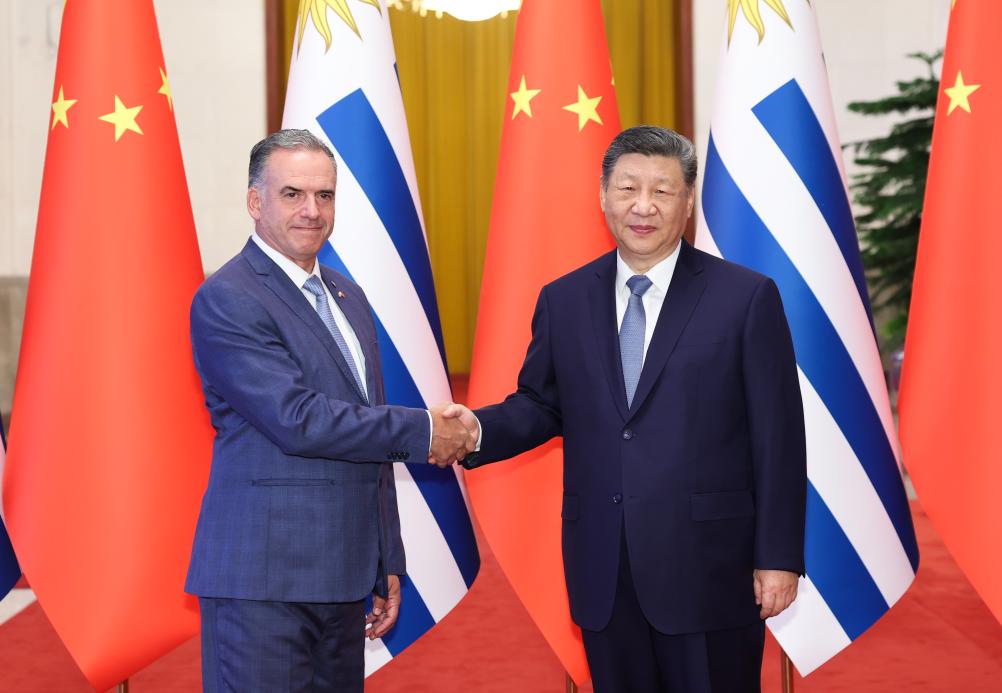
During Uruguayan President Yamandú Orsi's state visit to Beijing, China and Uruguay are elevating their ties toward a global strategic partnership. Over 10 agreements on trade, technology, and multilateralism have been reached, with Xi Jinping taking a swipe at "unilateral bullying.".
China and Uruguay strengthen their strategic partnership: meeting in February 2026
On February 3, 2026, at the Great Hall of the People in Beijing, Presidents Xi Jinping and Yamandú Orsi signed a joint declaration elevating China-Uruguay relations to a "comprehensive strategic partnership," strengthening cooperation in trade, investment, and emerging sectors. The document, relaunched by Xinhua and Uruguayan agencies, emphasizes the country's commitment to UN multilateralism, bilateral trade (China is Montevideo's primary partner), and support for Chinese initiatives such as the Global Security Initiative (GSI). Xi took the opportunity to criticize "unilateral bullying," a veiled reference to the United States.
Context of the visit and the agreements signed
Orsi's state visit (February 1-7, 2026) resulted in over 10 MoUs on trade, investment, industry, and innovation, signed in the presence of the leaders. Among the focuses were supply chains, standardization, trade facilitation, and the green and digital economy—with Uruguay exporting soy, meat, and dairy products to the Asian giant (2024 budget: USD 6.59 billion, +251 TP3T). Uruguay reaffirms the "one-China" principle, opposing "Taiwan independence" and recognizing Beijing as the sole legitimate government. The agreements aim to diversify beyond raw materials into AI, biotech, and infrastructure, aligning with the Belt and Road Initiative (BRI).
Economic Impacts: Opportunities for Uruguay and China
China, Uruguay's primary market, will import more high-quality agricultural products and encourage Chinese investment in agribusiness, clean energy, and logistics. Orsi has pushed for a business-friendly environment, with joint committees to optimize trade (Uruguayan exports +411 TP3T in 2024). For Beijing, Uruguay is a bridge in Mercosur: a strategy for resilient supply chains, green tech, and digitalization, reducing unilateral dependencies. Prospects? Growth in biomedicine, sports, and people-to-people tourism.
You may also be interested in:
Xi Jinping gives instructions to the China Natural Science Foundation: Here's what he said
Geopolitics: Multilateralism and the Relationship with Washington
The joint statement praises the GSI, the Global Development Initiative (GDI), and the Global Civilization Initiative (GCI), with the UN's commitment to combating hegemony. Xi called for "sovereign equality and international law," while Orsi praised China's multipolar vision in Latin America. Against a backdrop of US-China tensions, this strengthens Beijing's influence in the Southern Cone, with Uruguay as a stable ally against "bullying.".
Future prospects and reactions
Both sides will commit to building on the consensus reached through established mechanisms such as the China-Uruguay Economic and Trade Committee. Reactions in Montevideo and Beijing were immediate, all positive, with enthusiastic descriptions such as "a transcontinental bridge destined to last for decades." In 2026, a crucial year for the Belt and Road Initiative, this strategic partnership will further accelerate economic integration between China and Latin America.