






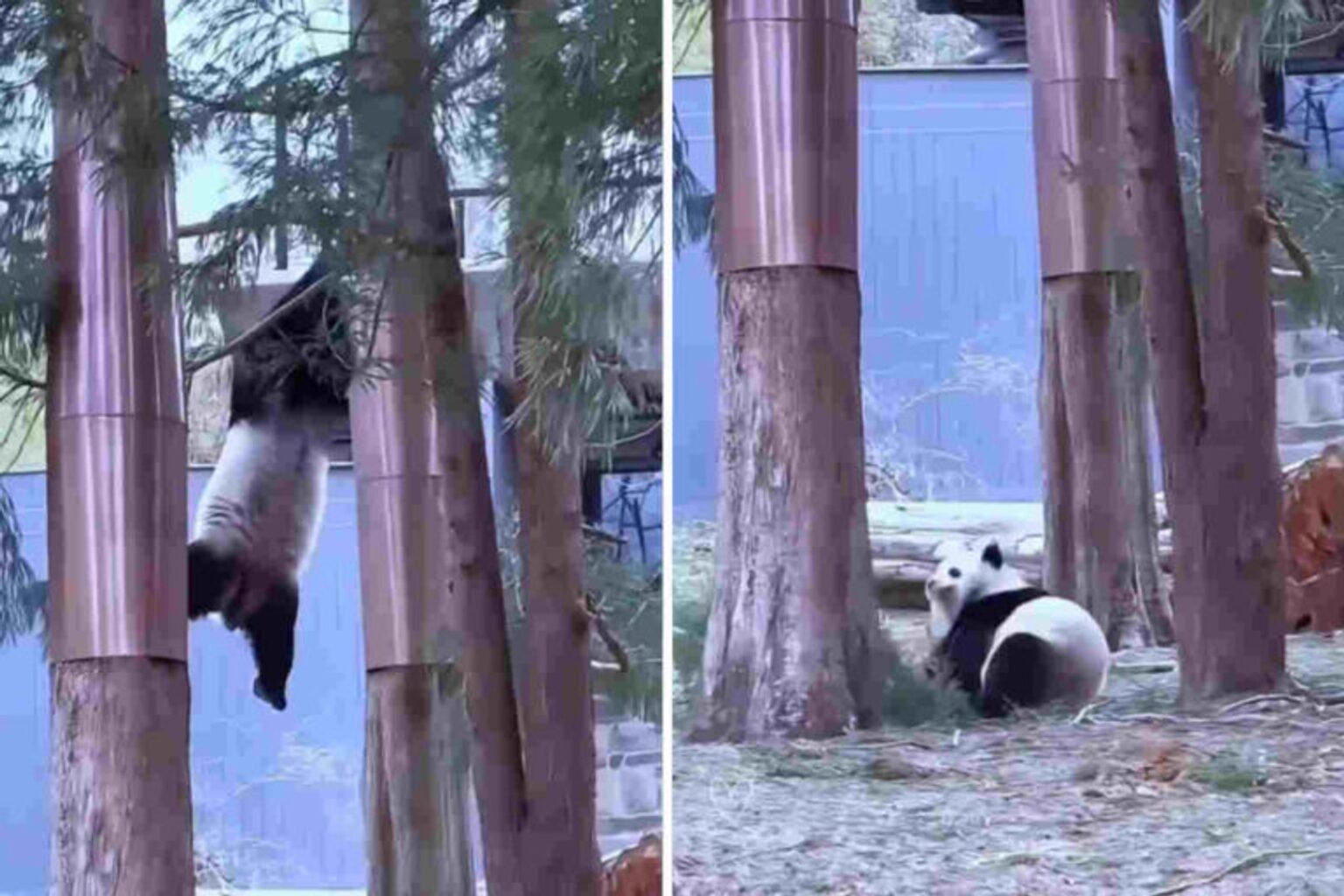
Giant pandas often fall, slip, roll, and lose their balance, but this doesn't always mean they've hurt themselves. In most cases, these are related to their movement, their body weight, and their environment, especially when climbing or descending trees. Many social media users are easily shocked by clips of this beautiful protected species falling from trees or from the toys in the Panda Garden. But let's clarify some key points.
Giant Panda Falls: Why Do They Fall?
The giant panda is often perceived as clumsy, but it is actually an animal capable of climbing and moving with a good deal of adaptation. Falls can occur due to a misstep, a slippery surface, an unstable branch, or simply during play, especially in cubs. The panda's physical structure contributes to some movements being less graceful than those of other arboreal mammals. A massive body, robust limbs, and a less than light center of gravity can transform a descent into a spectacular slide, even when the animal is not in actual danger.
When they can get hurt
The risk increases if the fall occurs from a significant height or onto a hard surface. In these cases, a panda may suffer bruises, sprains, or more serious injuries, especially if it is very young, elderly, or already debilitated. An isolated incident, however, isn't enough to indicate that the animal is ill. Keepers and veterinarians primarily observe its behavior after the fall. If the panda gets up, walks normally, eats, and resumes its routine, there are often no significant consequences; if, however, it limps, avoids movement, or shows signs of pain, a more thorough evaluation is needed.
The behavior of the keepers
In zoological centers and conservation facilities, keepers work with pandas in a very careful and supervised manner. At the Smithsonian National Zoo, for example, the relationship with the animals is based on daily observation, positive reinforcement, and voluntary cooperation, thus reducing stress and allowing for safe monitoring and care. For this reason, it's incorrect to imagine keepers picking up pandas "by the head or fur" as a routine practice. Direct physical contact is not the norm. Modern management focuses instead on encouraging the animal to cooperate, avoiding unnecessary manipulation and favoring safe and progressive procedures.
What they observe after a fall
After a fall, staff check the panda for limping, stiffness, reluctance to move, loss of appetite, or changes in behavior. These signs help determine whether it's a simple slip or a problem requiring veterinary attention. Young pandas require even more attention because their coordination isn't fully developed. In adult pandas, however, their body weight makes any impacts from a height more delicate, although the animal can still recover quickly from minor injuries.
A strong but not invulnerable animal
It's important to avoid two extremes: on the one hand, thinking that the panda is so fragile that it gets hurt every time it falls, and on the other, believing that its funny appearance makes it almost indestructible. The reality is more balanced. The panda is a robust animal, but like any large mammal, it can suffer if it falls badly. Many viral scenes show pandas rolling or sliding comically, but behind that image is a real animal, with specific physical needs and behavior that must be interpreted in context. In the wild and in captivity, the difference between a clumsy slip and a serious accident lies primarily in the height, the surface area, and the speed with which the animal returns to normal behavior. Giant panda falls aren't always dangerous, but they shouldn't be trivialized. Most remain without serious consequences, while keepers and veterinarians are trained to recognize the signs of potential trauma and intervene when necessary.