






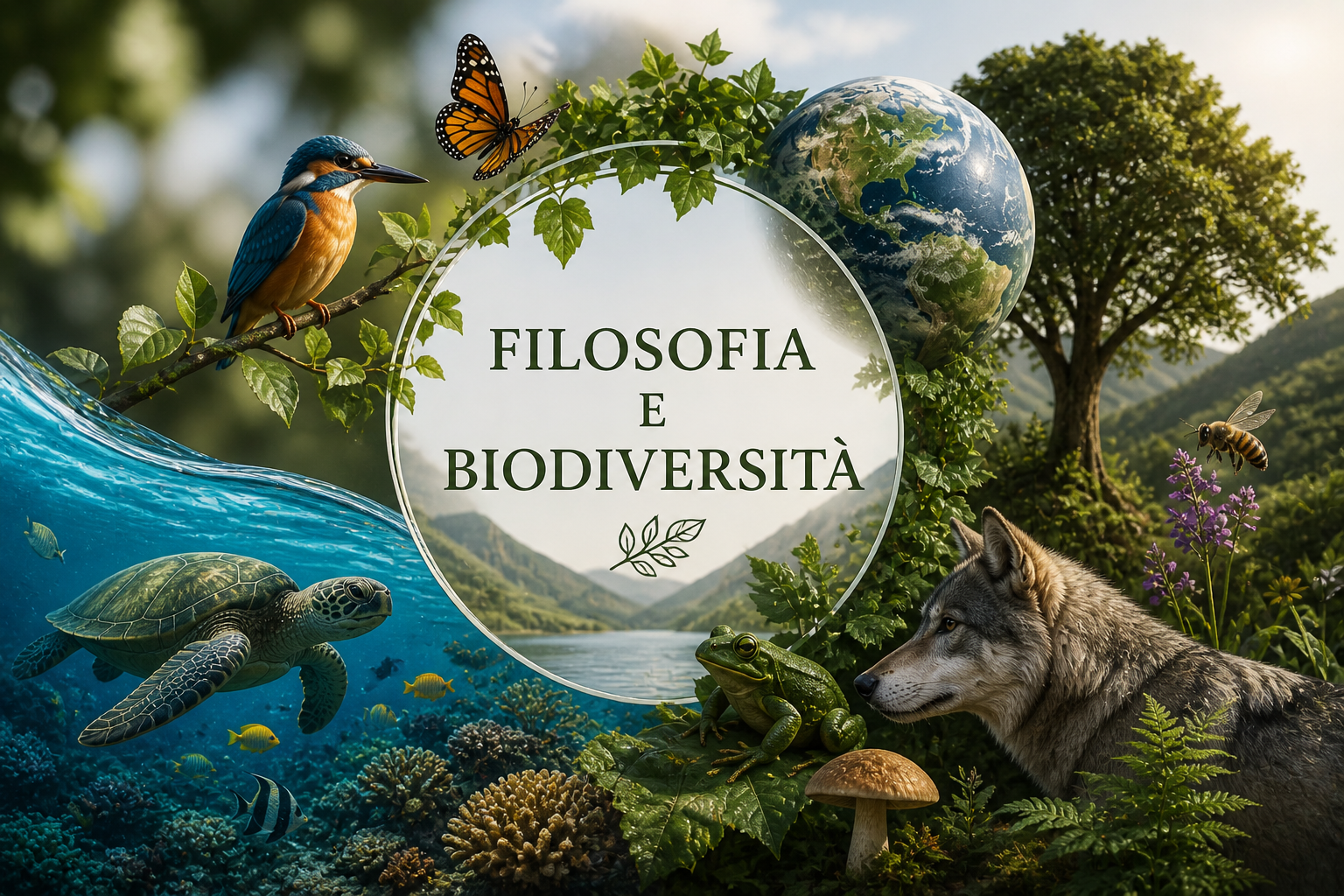
From Hans Jonas to Arne Næss, passing through Sahotra Sarkar and the thought of complexity. Philosophy helps us understand the value of biodiversity.
There biodiversity It's not just the number of species populating the Earth. It's the living fabric that makes ecosystems, the planet's stability, and, ultimately, our very survival possible. This is why discussing it philosophically isn't an abstract exercise. It means questioning the value of nature, the limits of anthropocentrism, and our responsibility toward future generations. In a historical moment marked by accelerated habitat loss, species extinction, and the climate crisis, biodiversity has become one of the great issues of our time. Philosophy, for its part, offers valuable tools for understanding what we are truly losing when we lose biological diversity. Not just resources, but relationships, balances, and possibilities for the future.
Biodiversity and Philosophy: The Ethics of Responsibility
Among the most important thinkers in this field there is Hans Jonas, which placed the principle of responsibility at the center of his reflections. According to Jonas, humankind's technological power has become so great that it imposes a new moral duty: to act in a way that does not compromise the lives of future generations. Applied to biodiversity, this idea is crystal clear. If our actions alter ecosystems, food chains, and natural habitats, it is not just an environmental problem, but an ethical one. Jonas helps us understand that protecting living things cannot be postponed, because ecological damage is often irreversible.
Deep ecology
Another decisive school of thought is the’deep ecology Of Arne Næss, who proposed overcoming anthropocentrism in favor of an ecocentric worldview. For Næss, nature is not only valuable for what it produces or enables humankind, but possesses intrinsic value. This perspective is crucial for biodiversity because it completely changes the way we understand conservation. It's no longer a matter of protecting nature simply because it's "useful," but because every form of life deserves respect as part of an interdependent network. In this vision, the protection of ecosystems is not a matter of resource management, but an ethical principle of civilization.
The philosophy of biology
Alongside environmental ethics and deep ecology, the philosophy of biology It helps clarify that biodiversity is not a generic concept, but a complex reality involving species, genes, habitats, and evolutionary processes. In this context, Sahotra Sarkar It is one of the most important references, because it has explored the philosophical meaning of biodiversity and the theoretical difficulties of its definition and protection. This approach is also valuable for public debate. It reminds us that biodiversity is not an abstraction, but a concrete condition for ecosystem resilience. Where diversity declines, fragility, imbalances, and environmental vulnerability increase.
You may also be interested in:
Wildlife and forests in China: the story of a natural heritage that matters to the planet
Giornata Mondiale della Biodiversità: significato, origine e perché è importante
The thought of complexity
The biodiversity crisis cannot be read as an isolated phenomenon. This is where complexity thinking comes into play, particularly associated with Edgar Morin, which invites us to consider environmental problems as interconnected systems. Species loss, pollution, deforestation, and climate change are different aspects of the same crisis in the relationship between humans and the planet. This vision is also very useful for scientific and environmental communication, as it allows us to move beyond simplified narratives. Biodiversity is not a sectoral issue: it is the intersection of ecology, economics, politics, culture, and intergenerational justice.
Why does it concern us too?
Looking at biodiversity through the eyes of philosophy means changing perspective. We are not external spectators of nature, but part of it. And if nature is impoverished, so are our societies, our food security, our quality of life, and our ability to imagine a sustainable future. Protecting the panda is not just about a symbolic species, but the fate of forests, habitats, and entire ecosystems.
Talking about biodiversity philosophically therefore means combining dissemination, culture, and civic responsibility. Biodiversity is a scientific issue, but first and foremost it is a question of perspective. Hans Jonas speaks to us of responsibility, Arne Næss of interdependence, Sahotra Sarkar of the complexity of the concept, Edgar Morin of the relationships that hold living things together. Together, these thinkers remind us that defending ecosystems means defending the very possibility of life. Therefore, biodiversity is perfectly interconnected with philosophy.