






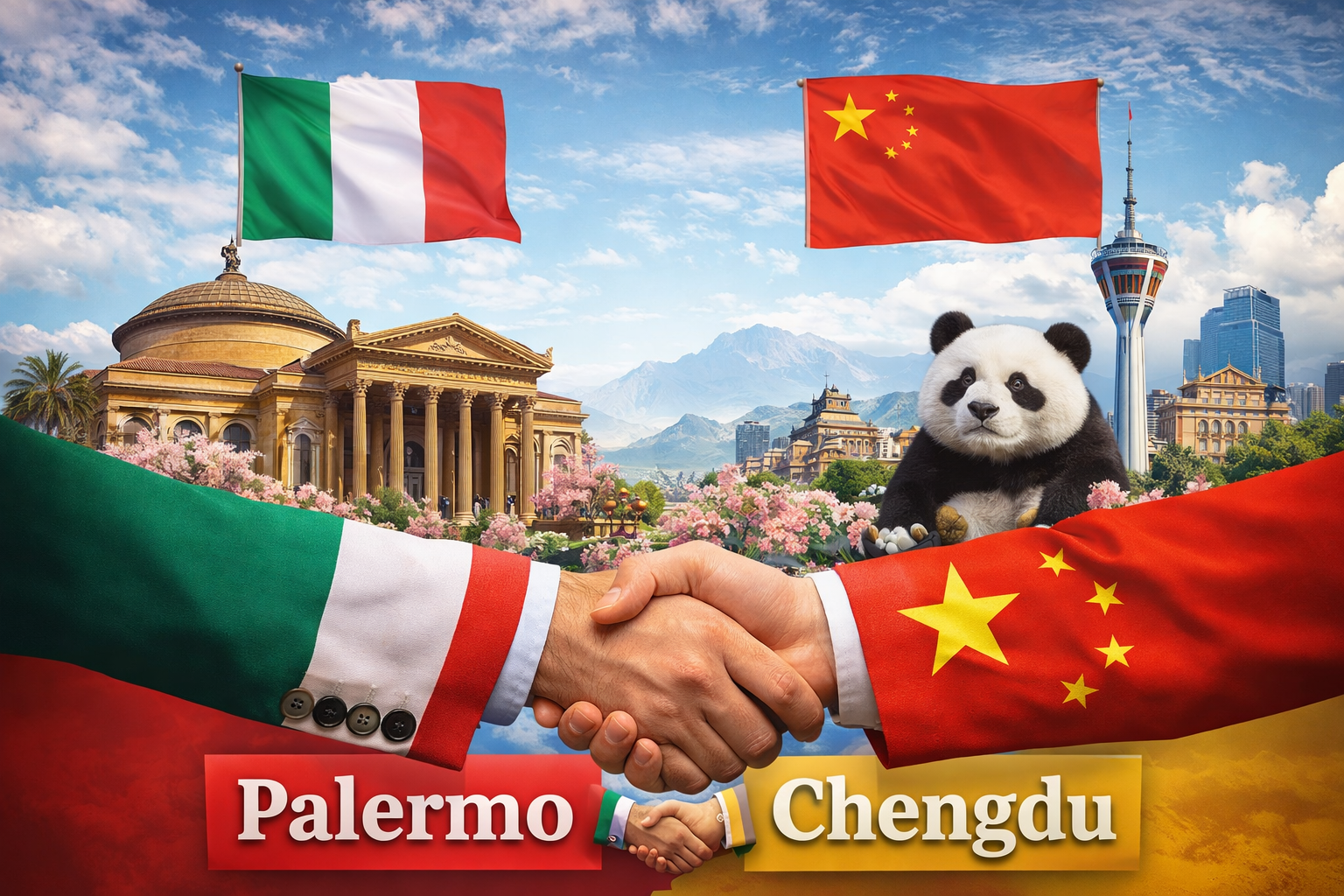
The history of the twinning between Palermo and Chengdu It's very interesting and absolutely worth visiting! At first glance, the two cities seem polar opposites. One overlooks the Mediterranean, a melting pot of Arab, Norman, and Phoenician cultures; the other, in the heart of southwestern China, the kingdom of pandas and a high-tech metropolis of 20 million inhabitants. Yet, since 1999, they have been twinned. This union is no coincidence, and their history deserves to be told calmly and in great detail.
Palermo-Chengdu twinning: the story: how and why it all began in 1999
It was 1999 when Palermo and Chengdu signed the history of their twinning agreement. Chengdu, the capital of Sichuan province, was accelerating its opening to the world following China's economic reforms of the 1990s. It sought international partners to grow in culture, economics, and innovation, and it chose Palermo for good reason. Why Palermo? Palermo represented the perfect bridge to Europe. A UNESCO city for its Arab-Norman heritage, a Mediterranean hub with centuries of trade with the East—think of the Islamic influences in its markets and palaces.
The delegations met in a climate of mutual enthusiasm. Chengdu saw Palermo as a symbol of resilience and multiculturalism, ideal for its internationalization plans. Palermo, for its part, saw opportunities to export wine, fashion, and tourism to an emerging market. That protocol wasn't just paper: it sealed promises of student exchanges, cultural festivals, and trade missions. From there, the bond strengthened year after year, becoming a model for the more than 80 twinned couples between Italy and China.
Why Palermo? The strategic reasons behind the choice
It wasn't love at first sight, but a thoughtful choice. Chengdu, known as "The Panda City," was targeting European cities with unique appeal. Palermo stood out for three main reasons. First, its UNESCO World Heritage status. The two sites share an ancient legacy that facilitates discussions on conservation and cultural tourism. Second, its geopolitical position. Palermo is the gateway to Sicily, a region with strategic ports for exports to Asia. Third, its economic potential. China wanted to sample Sicilian agri-food products—oranges, wines, pistachios—while Palermo dreamed of Chinese tech and investment.
Palermo, in fact, is not just beautiful, it's functional. It's the meeting point between Europe and Africa, perfect for teaching Chengdu how to manage multicultural metropolises. And vice versa. Palermo learns from Chengdu smart city models, with green parks and high-tech metro systems. This complementarity has made the twinning strong, resilient to global crises like the pandemic.
The fundamental importance: a bridge for tourism, culture and business
This twinning is crucial because it goes beyond rhetoric. It generates real value. Just consider tourism. After Xi Jinping's visit to Palermo in 2019, Chinese tourists settled in Sicily, with an annual increase of 301 TP3T, appreciating its artistic, cultural, and educational beauties. Not to mention the culture. Fusion festivals combine arancini and hotpot, while art travels between the two hemispheres. The University of Palermo, with its New SEASON project, sends students to Chengdu to study, and they return to Sicily with ideas for green startups. Business-wise, it's a river of opportunities: Sicilian exports to Sichuan, imports of tech gadgets, and agreements with Sicindustria. In a globalized world, this connection positions Palermo as a smaller Italy-China hub, less crowded than Milan but equally profitable.
What you need to know: projects, events, and key numbers
Let's now delve into the heart of the story, with the concrete facts that make this twinning so tangible. Since 1999, the two cities have never stopped meeting: think of dozens of reciprocal missions, with Chinese delegations arriving in Palermo to closely observe Mediterranean urban planning, the regenerated alleyways, and the secrets of multicultural coexistence, while groups of Palermitans fly to Chengdu to immerse themselves in panda tourism fairs, among conservation centers and strategies to attract global visitors. The numbers speak for themselves: every year, over 200 students commute between the University of Palermo and SWUFE, the Chengdu University of Economics, bringing with them fresh ideas on finance, tech, and sustainability.
And the events? The key ones are the dialogue on Italy-China twinning, where Palermo always has a front-row seat, and the workshops pushing for direct flights—imagine a non-stop Palermo-Shanghai flight soon, within reach. Today, the projects live and breathe. UNESCO collaborations to enhance shared heritage sites, Palermo eco-hubs inspired by Chengdu's panda parks with their high-tech green oases, and an e-commerce boom on WeChat connecting Sicilian artisans to millions of Chinese consumers. Sure, there are challenges—language, bureaucracy, distance—but AI and platforms like TikTok are already melting them away. And the future? 2030: shared university campuses, with classrooms connecting Palermo and Chengdu.
| Key element | Palermo offers | Chengdu Gate | Real impact |
|---|---|---|---|
| Tourism | UNESCO sites, food | Panda Tours, Luxury | +100k Chinese visitors |
| University | Asia Courses | Tech-finance | 200+ exchanges/year |
| Business | Agro-fashion | Tech investments | +50% export Sicily |
| Sustainability | Regeneration of centers | Green parks | Shared ESG models |
The future: why is this twinning more alive than ever?
In 2026, the twinning between Palermo and Chengdu is more vibrant than ever. After the challenging years of the pandemic, the recovery has brought new energy and new opportunities, while interest in Italy's "soft power" is growing in China. For Sicily, all this translates into a valuable lever. A bond capable of generating themed trips dedicated to pandas and Sicilian culture, exchange programs and internships in China, as well as economic and professional collaborations for those looking to the East. It's a story that has never stopped – beginning with a pact signed in 1999 and destined to leave a legacy for future generations.