






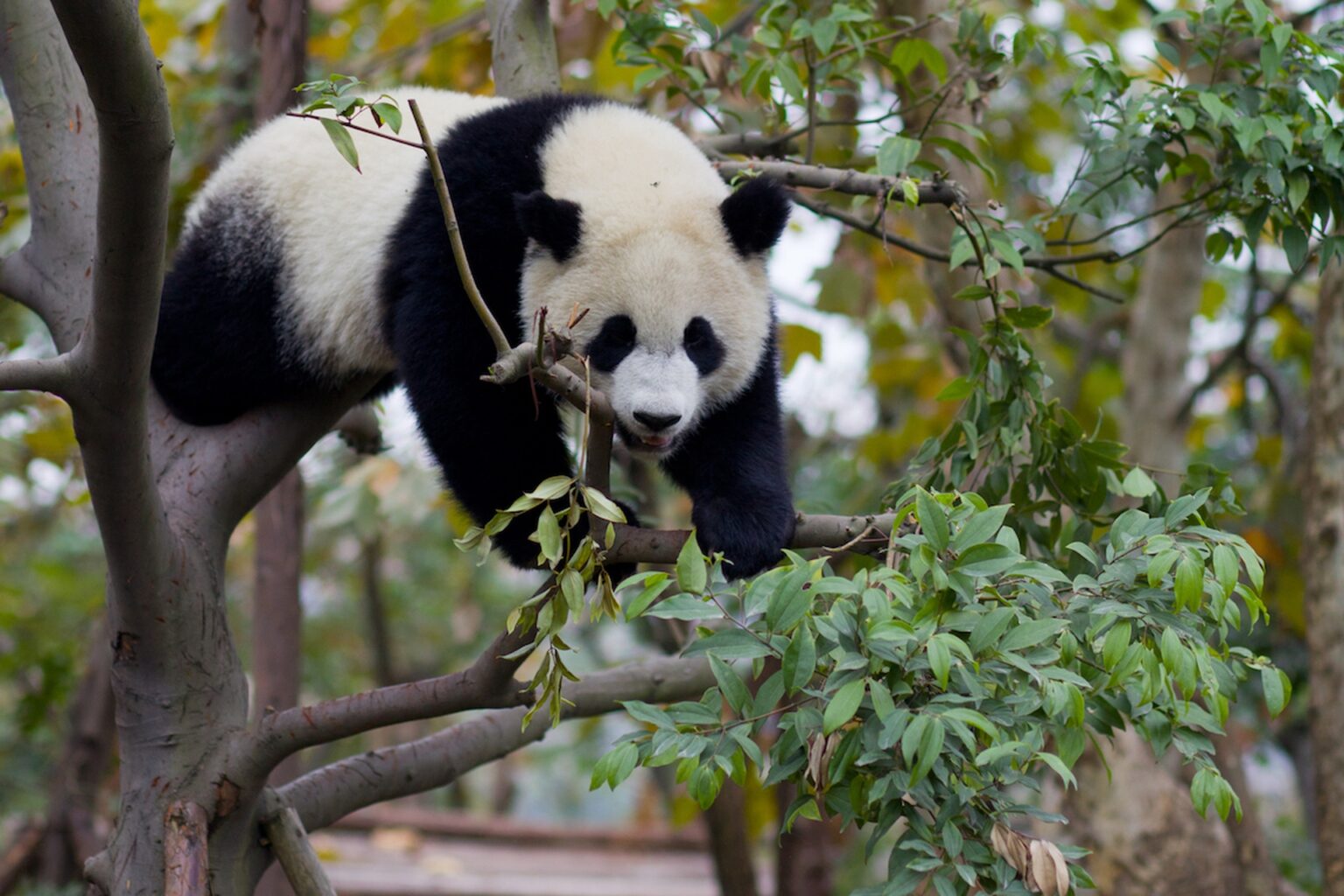
The giant panda It's the most underrated animal in the world, and it's always been. When you think of the giant panda, an unconditional reflex inevitably kicks in: either you laugh or you smile. As if it were an antidote to sadness. The reason? The answer is almost always the same: "because it's cute and cuddly." And it's precisely from this point that we should start and reflect. Everyone loves the cuddly little bear for its irresistible look: black paws, white belly, teddy bear face. But despite this superficial adoration, it is also unwittingly considered the most underrated animal in natural history. And that's a real shame! To truly understand it, we must free ourselves of prejudices and immerse ourselves in a profound, almost transcendental study. Perhaps one aspect that no one focuses on, and which is one of the main reasons, in my opinion, to reflect and ask the right questions, is: why is the panda loved, especially by children, yet, at the same time, forgotten and undervalued by the public? Perhaps because, being inaccessible for obvious reasons (protected species, economic constraints, and logistical issues), it tends to be overlooked. Yet, it is undoubtedly the most interesting and fascinating animal in existence (without taking anything away from other animals).
The giant panda is the most underrated animal in the world: the myth that needs to be debunked.
The question arises: if it inspires tenderness and hilarity, why is the giant panda the most underrated animal in the world? Let's start with the most deeply rooted prejudices we carry about the giant panda, which everyone imagines as eternally lazy and clumsy. A Buddhist monk lying down gnawing bamboo for 12-15 hours a day. But if we scratch this surface, a brilliant evolutionary adaptation emerges, one that varies markedly between pandas in the wild and those in captivity. Take the wild ones, in the dense bamboo forests of Chinese mountains like Sichuan. They are carnivores by DNA, with a 95% gene pool similar to a bear, but they have specialized in an almost exclusive diet of fibrous bamboo because meat is scarce in those remote mountain habitats and because their stomachs are similar to those of carnivores but essentially vegetarian. They devour between 20 and 40 kg every day. To compensate for a gut that barely digests 17% in food. The rest becomes those epic "green masses" they excrete. An inefficient cycle, but vital for survival. It's not laziness, it's a deliberately "slow" metabolism that conserves energy in hostile environments, allowing them to survive for 2-3 million years.
Different, but complementary, the case of pandas in captivity, like those at the Chengdu Research Base. Here, the "Zen work" of chewing for hours remains, but it's optimized with supplemental diets—fresh bamboo, nutritious pellets, and the occasional fruit and treats made with rice or corn flour—to maximize health and reproduction. In-depth studies at these centers reveal that their low metabolism isn't a matter of clumsiness, but rather a way to store reserves for harsh winters or bamboo blooms that only occur every few decades. Let's break free from prejudice. In nature, In fact, it's pure wild resilience, a model of efficiency designed for conservation in captivity. Imagine these giants not as sleepyheads, but as nature's silent strategists. Contrary to popular belief!
Deep Biology: A Body Against Evolution
Let's forget about the "cub that resembles a child" prejudice, that veil that makes us see the giant panda as a clumsy teddy bear. The reality is far more fascinating, and official data from sources like the WWF and Chinese conservation centers demonstrate this precisely. Let's talk about adults in the wild: males weigh between 85 and 125 kg, females 70 to 100 kg, with a solid build that hides a camouflaged athleticism. They have that famous "opposable thumb"—actually a 3-4 cm long wrist bone—which acts as a perfect pincer for grasping bamboo stalks, snapping them, and peeling them with surgical dexterity. And their legs? Powerful enough to scale trees up to 4 meters high to rest or escape danger, and to swim rivers with fluid strokes for hundreds of meters. It's not clumsiness: it's a body designed for the rugged habitat of mountain forests between 1,200 and 3,500 meters.
In captivity, at the Chengdu Research Base or Wolong, these traits are refined. Adult pandas maintain their weight and agility thanks to controlled diets, with monitoring confirming similar leaps and climbs. But the real mystery—almost transcendental—lies in reproduction, which is the same in both wild and captive populations. Females enter estrus for only 2-3 days a year, between March and May. Males are selective and territorial, leading to extremely low natural success rates, around 20-30% even with human assistance. It's a merciless Darwinian cycle, defying human haste with cosmic patience. In captivity, breeding programs have produced over 400 cubs since 2000, but they require artificial insemination to overcome instinctive barriers.
The data
And here, WWF data for 2026 speaks clearly: approximately 1,800-1,900 wild pandas are estimated in Chinese reserves, a figure that is constantly growing thanks to the meticulous conservation and protection of the protected species. That low metabolic rate—20-30% lower than other bears—is their lifeline against climate change. They consume less, adapting to forests shrinking due to deforestation and warming. In the wild, it's raw survival. In captivity, it's a replicable model for the species. Do you understand now? Not eternal cubs, but silent warriors, ready to teach us what resilience truly is.
The Giant Panda, the World's Most Underrated Animal, Behavior: The Zen of the Transcendental Solitaire
Beyond viral "panda selfie" videos like Qingling's, which make us smile but leave it at that, lies an underrated and complex behavior, with nuances varying between giant pandas in the wild and those in captivity. In the wild, in the bamboo forests of the Sichuan and Shaanxi mountains, they are solitary creatures by instinct. They live in exclusive territories of 3-5 square kilometers, meeting only to mate or in rare cases of abundant food. They communicate little with sounds—that delicate, high-pitched "bleat," similar to a sheep's bleat, used mostly by cubs or during courtship—but mostly with an olfactory language that we are completely unaware of: scent markings on rocks and trees with anal glands, leaving clear messages of "territory occupied" or "female in heat." They are not naturally aggressive, but beware of invading. They defend their space with powerful, deep roars, rolling in the leaves or charging if necessary, though actual fights are rare.
False myths and prejudices about the protected species
The "shy, clumsy" prejudice? Another indication of why the panda is the most underrated animal in the world. Totally false. In the wild, they climb tree trunks up to 10 meters high to rest or escape, they fight by pushing and scratching for dominance, they migrate along steep slopes chasing bamboo blooms. It's an active, not passive, existence. It's different in captivity, in base camps like Chengdu or Dujiangyan. Here, solitude is attenuated in shared enclosures for controlled sociality, with more frequent bleats to attract the keepers' attention and reduced marking thanks to optimized spaces. Roars emerge in competitions for food or during artificial estrus, but their "doing nothing" remains an art.
They angst, they sleep, they exist in a Zen rhythm reminiscent of Taoism—an essential, unfussy way of doing things, essential for finding balance and serenity. Ethological studies paint them as silent masters. In nature, it's raw survival against predators and famine. In captivity, however, it's an invitation to contemplate the essential. The giant panda isn't the cliché of a lazy teddy bear or a Chinese diplomat that prejudices have fed us for decades. This friendly little bear is a silent and extremely useful hero of nature. An ecosystem engineer who deserves our profound respect. Let's dispel these false myths once and for all—he's not clumsy, but an adaptable survivor; not shy, but a solitary philosopher; not a burden on China, but its engine of conservation.
Why is the giant panda our planet's hidden hero?
Imagine strolling through a bamboo forest in the heart of Sichuan. A giant panda gnaws peacefully, unaware that he is the silent hero holding that entire ecosystem together. He is not the lazy stuffed animal of our prejudices, nor a mere cute symbol. He is a living communicator of natural science, invaluable to the world, and deserves all of us to rid ourselves of false myths in order to understand and protect him. Think about it: while he chews 20-40 kg of bamboo a day, with his intestines absorbing only 17%, the panda spreads vital seeds through his feces—a natural fertilizer that regenerates dense forests. These forests are not just his home; they absorb CO2 at record rates, up to 10 times faster than degraded pastures, and support over 1,000 plant and animal species, regulating the flow of the Yangtze River, which supplies 67 million people. Without pandas, there is no seed dispersal and no regeneration: erosion, landslides, and desertification are advancing, as confirmed by 2026 studies by the Chinese Academy of Sciences on protected reserves.
And you, are you friends with the panda?
And it's not just in the wild. In centers like Chengdu Research Base, where they live in semi-freedom, breeding programs have produced over 400 cubs since 2000, with 20-30 annual releases boosting wild populations of 20% per decade (WWF and IUCN data). Every "domesticated" panda becomes an ambassador. They inspire global donations, finance habitats, and teach us about climate adaptation—that slow metabolism that challenges global warming. We, the entire world population, have the duty and power to raise public awareness, debunking the false myths of the "clumsy glutton," supporting scientific studies and ongoing conservation efforts for this protected species. The panda asks for nothing except the care of its habitat. Let's save it, and we will save ecosystems that nourish everyone. It's science, it's urgent. Act today, for a green tomorrow. After reading the article, I hope I've helped raise awareness among even a small niche, so that we can move from "the panda is the most underrated animal in the world" to "the panda is the most educational and fascinating animal in the world." Let's protect the planet and we will protect the giant panda!