






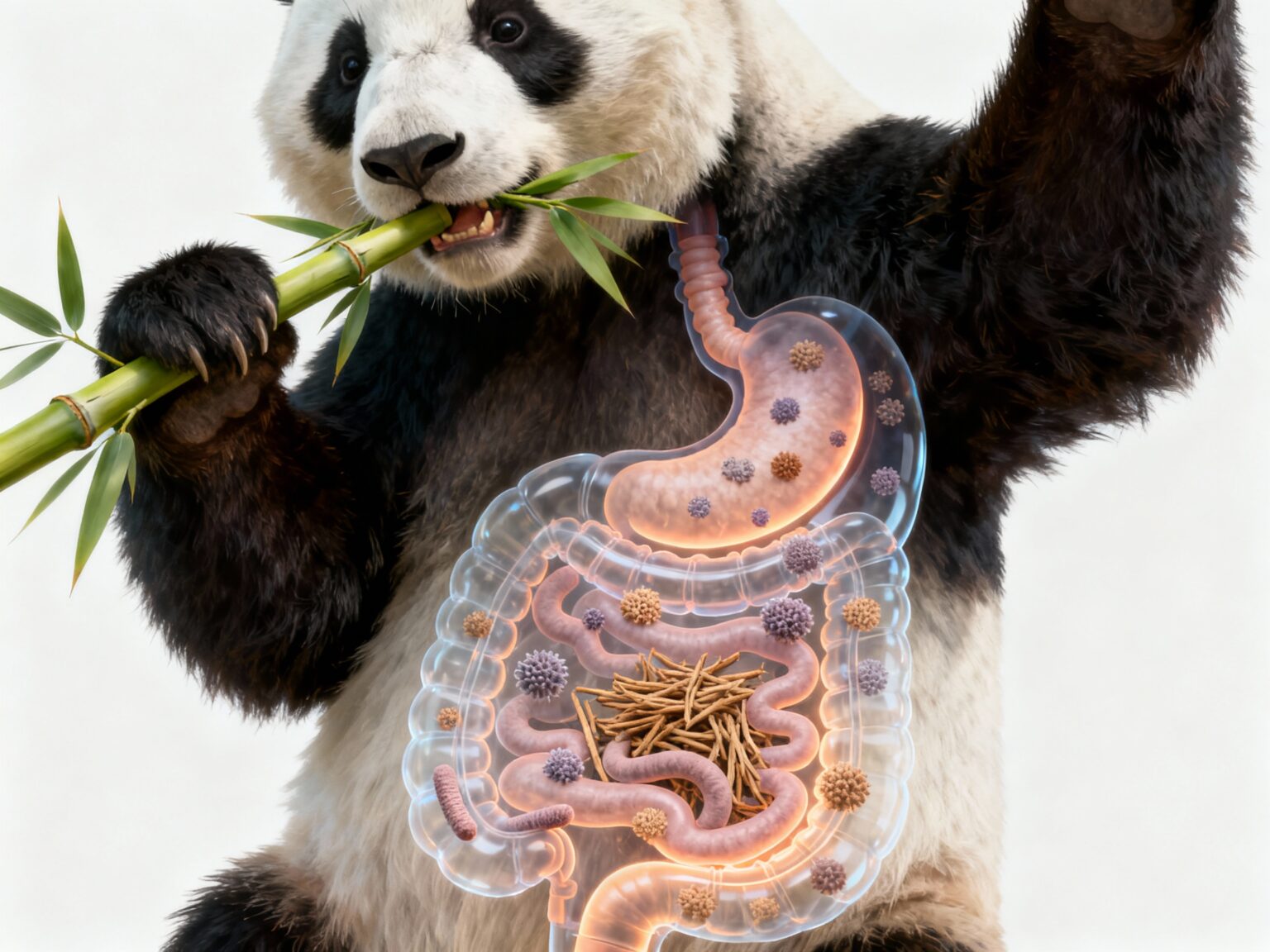
The giant panda spends up to 18 hours a day to devour bamboo. 99% of his diet is plant-based —and yet it belongs to the carnivorous group. An evolutionary paradox that has left scientists speechless and which, today, represents one of the most cited case studies in evolutionary biology. So... Why does the panda eat bamboo if it is not designed to digest it well? The answer is a brilliant mix of evolution, dietary opportunism, and digestive inefficiency transformed into a competitive advantage. The panda eats bamboo because it's a resource. abundant, not very competitive and rich in proteins that its carnivorous body is designed to absorb. Its short digestive system allows it to quickly eliminate difficult-to-digest fibers and retain what it really needs.
Why the panda (carnivore) eats bamboo: it is adapted to catch it but not to digest it.
A "herbivore" body... at least in appearance
The panda has developed perfect tools for handling bamboo:
- A pseudo-thumb to grasp it precisely;
- strong jaws and flat teeth to break it;
- a robust skull, designed for crushing tough fibers.
A textbook set of equipment. Or almost.
A totally carnivorous intestine
And here comes the twist:
- its intestinal flora is poor in bacteria that digest cellulose;
- Digestive transit is rapid, much more similar to that of a predator.
Result? The panda he chews little, assimilates only what is necessary (the proteins of the bamboo) and discards the rest at the speed of light.
How much energy does the panda really get from bamboo?
Not much. That's why he has to eat until 38-40 kg of bamboo per day to cover energy needs.
It only digests the 20% of ingested dry matter — versus the 60–90% typical of meat-eating carnivores. And what about when you don't eat? Sleeps up to 12 hours in total. Its metabolic business model is quite simple: eat for energy… to keep eating.
Do you ever eat meat?
Yes, but rarely. The panda it's not a good predator, so meat enters the diet only if it can be easily obtained. A very corporate approach:
“If a low-effort opportunity comes along, we evaluate it.”.
Why doesn't he go back to eating meat, if his body is predisposed?
Two strategic reasons:
1. The panda is an atypical hypercarnivore
Like the cat, it gets most of its energy from proteins. And the bamboo — surprisingly — provides enough to satisfy this need.
2. Bamboo is a “blue ocean” resource”
Abundant, available year-round, and difficult to digest for many other herbivores. The result? The panda conquers a niche where competition is minimal.
You may also be interested in:
Differences between giant pandas in the wild and giant pandas in captivity
March 16, World Panda Day 2026
Where does the giant panda live?
In nature, the panda is present only in China, in the provinces of Sichuan, Shaanxi, and Gansu. Most live in the mountains. Qinling e Minshan, in ecosystems where bamboo is dominant. Good news. The species has been reclassified from “in danger” a “"vulnerable"” thanks to a 17% increase in population.
What species of bamboo does it eat?
It depends on the region:
- Qinling: mainly Bashania fargesii e Fargesia qinlingensis
- Minshan: great variety of the genre Fargesia plus some species of Bashania
A diversified portfolio, in short.
A unique diet in the world: herbivorous on the outside, carnivorous on the inside
Recent studies have confirmed that, at the macronutrient level, the panda's diet is more similar to that of a carnivore than that of a herbivore. It obtains approximately 50% of energy from proteins, like wild cats and wolves. Its evolution didn't radically change its digestive system: it preferred to optimize what it already had. A change of strategy, not of structure.
The panda is an evolutionary anomaly… and a masterpiece of adaptation
The giant panda is a carnivore that eats almost exclusively bamboo, but not because it digests it well — on the contrary!
He does it because the perfect system is not the most efficient one, but the most advantageous one in the context. An evolutionary reminder that sounds surprisingly relevant even in the business world.