






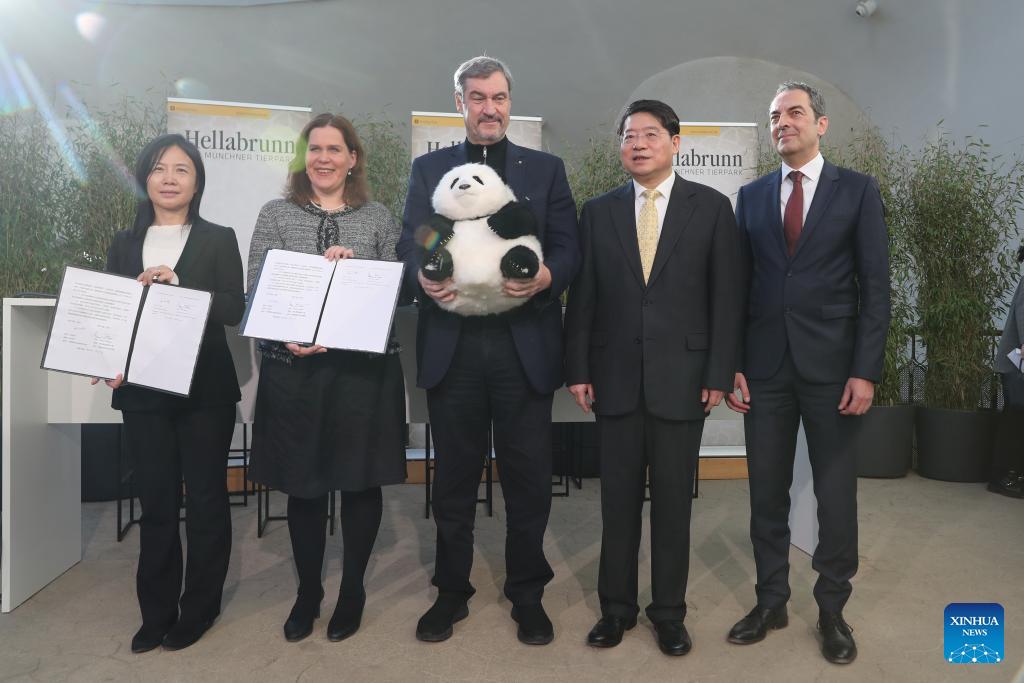
The agreement was signed on January 21, 2026, in Munich, during an official ceremony at Tierpark Hellabrunn, attended by Bavarian Minister-President Markus Söder, Munich's third mayor Verena Dietl, zoo director Rasem Baban, and representatives of the China Wildlife Conservation Association. The agreement provides for the arrival of two giant pandas from China by 2028, for a cooperation program lasting at least ten years, focusing on research, breeding, animal welfare, and international scientific exchange.
Giant pandas in Munich, China-Tierpark Hellabrunn agreement, arrival by 2028: a new "Panda City" in Europe
The agreement between Munich and China has been successfully finalized, and a pair of giant pandas will arrive by 2028. To accommodate the cuddly bears, Hellabrunn will create a new panda area of approximately 5,000 square meters in the Asia section, with large outdoor enclosures, climate-controlled indoor facilities, water pools, hills, and lush bamboo plantations to replicate the species' natural habitat. The project will be financed by the state of Bavaria with an estimated total investment of tens of millions of euros and will aim not only to ensure the animals' well-being but also to create a giant panda education center open to schools, families, and tourists.
Panda Diplomacy and Conservation
The presence of the pandas in Munich is part of a broader "panda diplomacy" strategy, through which China lends the animals to selected zoos in exchange for a formal commitment to conservation and research. The animals will remain the property of the People's Republic of China, and any cubs born at Hellabrunn will return to China after an agreed-upon period (usually upon reaching the age of four), contributing to the giant panda's ex situ breeding programs. The agreement with Munich also strengthens relations between Germany and China in the field of biodiversity protection, complementing the experience already underway at the Berlin Zoo, where pandas have been present since 2017: Meng Meng, Jiao Qing and the twin pandas, Meng Hao and Meng Tian.
What changes for the public and for panda enthusiasts
With the arrival of the pandas, Tierpark Hellabrunn is preparing for a significant increase in visitors and a new positioning as a leading destination for nature tourism in Europe. For panda lovers and nature photographers, the new area will offer close-up observation points, themed trails, multilingual information panels, and digital content dedicated to the biology, behavior, and conservation status of the giant panda. The facility's opening, scheduled for early 2028 after the first spatenstich scheduled for 2026, will be accompanied by special events, awareness campaigns, and educational programs aimed particularly at Bavarian schools. Germany has a federal structure with power divided between the national (federal) level and the 16 Länder (states), where each level has distinct responsibilities.
Main federal bodies
Legislative power belongs to the Bundestag (directly elected lower house, with principal powers) and to Bundesrat (represents the Länder, with the right of veto on laws that concern them). Federal Chancellor (currently Friedrich Merz) leads the government, defines the political lines and appoints the ministers, while the Federal President has a ceremonial role.
Hierarchy in the Länder
Each Land has its own parliament (Landtag), a regional government led by the Ministerpräsident (like Markus Söder in Bavaria) and their own ministries. The Länder manage education, police, culture, and healthcare; the federal government handles defense, foreign affairs, the economy, and the national budget.
Balance of power
The principle of subsidiarity It assigns powers to the Länder unless they are reserved for the federal government. The federal government (Bundesregierung) exercises executive power through the Chancellor, who coordinates the ministers according to the "ressort principle" (ministerial autonomy within general directives). A vote of no confidence in the Chancellor is "constructive," requiring the election of a successor.
Role of the State of Bavaria
Söder promoted the initiative during a trip to China in 2024, personally negotiating "panda diplomacy" to strengthen economic and cultural ties between Bavaria and Beijing; the loan agreement (for 10 years, expiring in 2028) was signed on January 21, 2026, in the presence of the Chinese ambassador. The state is financing the project (€18 million for the 5,000 m² enclosure plus €1 million annually in rent), directly managing Hellabrunn Zoo as an attraction and conservation tool.
Federal involvement
China decides on Panda loans independently for political reasons, but in Germany, the Länder have leeway with non-sensitive foreign cooperation (culture, environment); Friedrich Merz's federal government has not hindered them, in line with precedents such as the Berlin Panda loans (2017, granted by Xi Jinping to Merkel). Söder presents it as the "pinnacle of Bavarian-Chinese diplomacy," with no obvious hierarchical conflicts.