







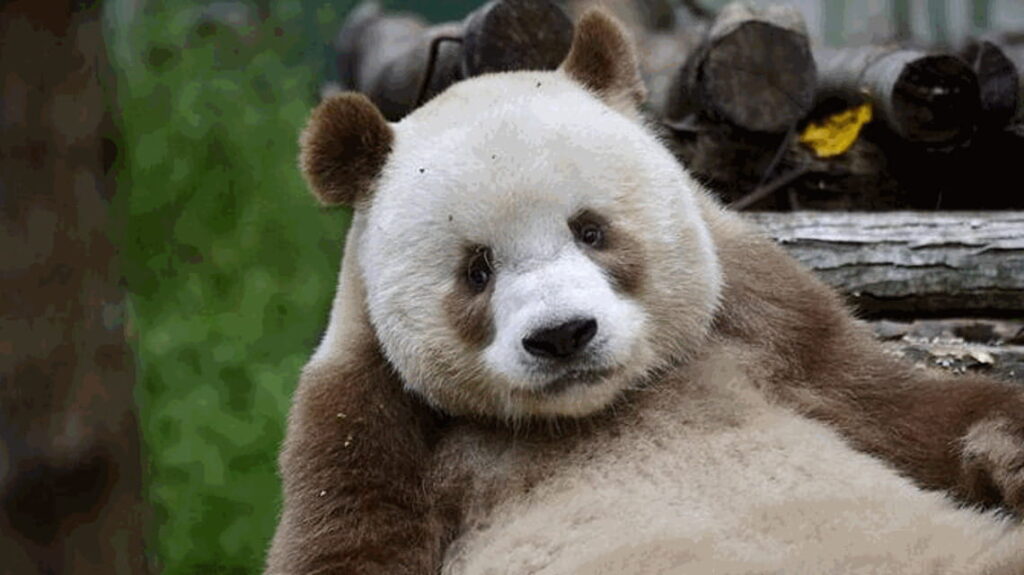
There's a very special panda found in the mountains of the Foping reserve, in China. His name is the boss Qizai, and his peculiarity certainly doesn't go unnoticed, as does his touching story. His fur, instead of the classic black and white, boasts an unusual and fascinating light brown color. His skull is smaller and his molars are larger, offering scientists valuable clues about his adaptation, genetics, and conservation. These adaptations, in fact, could be linked to his diet and the mountain environment in which he lives. This rarity has made him a true celebrity, unique in the world, attracting the attention not only of the media but also of scientists intrigued by his unique coat.
The Boss Qizai, the moving story: the first sighting
The Qinling panda is a little-known cousin, with cinnamon-colored fur and a past that separated from that of the Sichuan pandas about 300,000 years ago. His name, Qizai, affectionately means "Seventh Child," and he was born on July 22, 2009. His touching story begins rather turbulently, way back in 2009. Qizai was just a month-old cub when his mother decided to abandon him. Experts believe this may have been linked to his unusual coloration. Imagine a little brown furball in a world of black and white. Perhaps his mother didn't recognize him or didn't know how to care for him. In any case, the sweet Qizai is not an albino panda, as one might think. His chocolate-colored fur is the result of a rare genetic mutation. Consider that only six other pandas with this particular coloration have ever been sighted in history. In fact, they all came from the same mountainous area of Qizai, the Qinling Mountains. The first documented sighting dates back to 1985, with a specimen named Dandan.
The Irresistible Allure of the Giant Panda: An Analysis of Its Beauty
All about brown and white pandas: How many brown pandas are left in the world?
How many cubs do giant pandas have? All the curiosities
Punch, the little macaque abandoned by his mother
Differences between Sichuan pandas and Qinling pandas
Argument between Abao and Qi Zai
Marginalization by other pandas
After being found abandoned in Foping County, Shaanxi Province (Qinling Mountains) on November 1, 2009, he was initially rescued there. He currently resides at the Qinling Four Rare Animals Science Park (or Research Center for the Qinling Giant Panda, part of the Shaanxi Rare Wild Animal Breeding Center in Louguantai, Zhouzhi County, Xi'an). Qizai was immediately taken to the Louguantai Animal Protection Center, not far from the large city of Xi'an. There, unfortunately, he faced truly difficult times. The other pandas, with their distinctive fur, had begun to ostracize and mock him. He was different, and this, in the animal world, as in the human one, can sometimes lead to misunderstandings, not to mention that this very aspect can truly be an added bonus as well as a true asset.
Fortunately, the reserve keepers have always cared for him with unconditional love and dedication and he was later adopted by the giant panda Zhu Zhu. The tender mother immediately took care of the helpless cub. In fact, every day, Qi Zai was given about 50 kilos of bamboo shoots, his favorite food. Thanks to this attention, boss Qi Zai has always grown strong and healthy, weighing over 100 kg.
And his story also had a positive impact from an emotional point of view. Over time, this beautiful panda managed to find a life partner, with whom he had a cub, including Qin Hua nel 2020. Successivamente, con la seconda compagna, Zheng Zheng, ha avuto nel 2021 il piccolo Ba Zai. E, successivamente, avrebbe avuto anche un terzo figlio (non ancora confermato attraverso l’esame del DNA) chiamato Rong Rong, nato nel 2022 dalla relazione con Jin Xin (锦心) e, infine, avrebbe avuto anche l’unica figlia femmina (non ancora confermata attraverso l’esame del DNA), Quan Yun. Quest’ultima sarebbe nata dalla relazione con Ming Ming nel 2021. Il tenero pandino ha il manto bianco e nero ma presenta delle macchie nere sul musetto.
The stages of Qi Zai's transfer
The center has existed since 2006 as the Qinling Giant Panda Research Institute (scientific phase), but has only been open to the public since June 13, 2021. Qi Zai has been living there since 2014, transferred from the Foping National Nature Panda Reserve for adaptation and reproduction, in areas not accessible to visitors until the public inauguration.
- 2009: rescue at Foping Reserve.
- 2009-2014: Shaanxi Rare Wildlife Rescue Center (Louguantai).
- December 2014: transferred to Qinling Giant Panda Research Center (pre-public).
The genetic mutation
This variant is recessive: only pandas that inherit the mutation from both parents display brown fur, while "mixed" carriers remain visually black and white. The mutation was detected exclusively in the Qinling population, explaining why brown pandas appear only in this restricted area and why so few known individuals exist. Science, of course, could not ignore such a rare and fascinating case. Recent studies, published in prestigious scientific journals such as PNAS and reprinted by Nature, have finally solved the mystery of Qizai's fur color, analyzing its rather moving story.
Researchers discovered that a small missing DNA sequence in a gene called Bace2 is responsible for this anomaly. This gene produces a protein essential for hair pigmentation, and its "defective version" in Qizai leads to impaired production of the protein. Furthermore, the hair of the well-known giant panda contains a lower amount of melanosomes, the organelles that produce pigment, and these melanosomes are also smaller than those of "traditional" giant pandas. Genetic analyses also conducted on the first documented brown panda, Dandan, confirmed that both shared this same genetic anomaly. This suggests that the genetic variant emerged long ago, around 300,000 years ago, when a small group of pandas separated from their peers and lived isolated in the Qinling Mountains.
The touching story of Qizai the boss and his unique characteristics
Despite the initial difficulties, the boss Qizai has become a real celebrity thanks to his unique characteristics exactly like director Hua Hua. His moving story is a powerful symbol of how diversity, while it can be a hindrance, can also be a strength, a unique and special element. His clumsiness and slowness, perhaps linked to his uniqueness, made him vulnerable in the group, but the unconditional love of his guardians protected and cared for him.
Indeed, the Chinese media have followed the story of this extraordinary specimen with great interest. Qizai is the only brown panda living in captivity in the world. His popularity has grown steadily over the years, so much so that he has even appeared on television. In 2020, he received further recognition: he was adopted by the Panda International Organization. Today, Qizai lives peacefully in his home, the Foping Nature Reserve, in the Qinling Mountains. However, it seems that only a few hundred brown pandas still exist in the wild, but Qizai remains a one-of-a-kind icon under the care of loving "panda nannies.".