






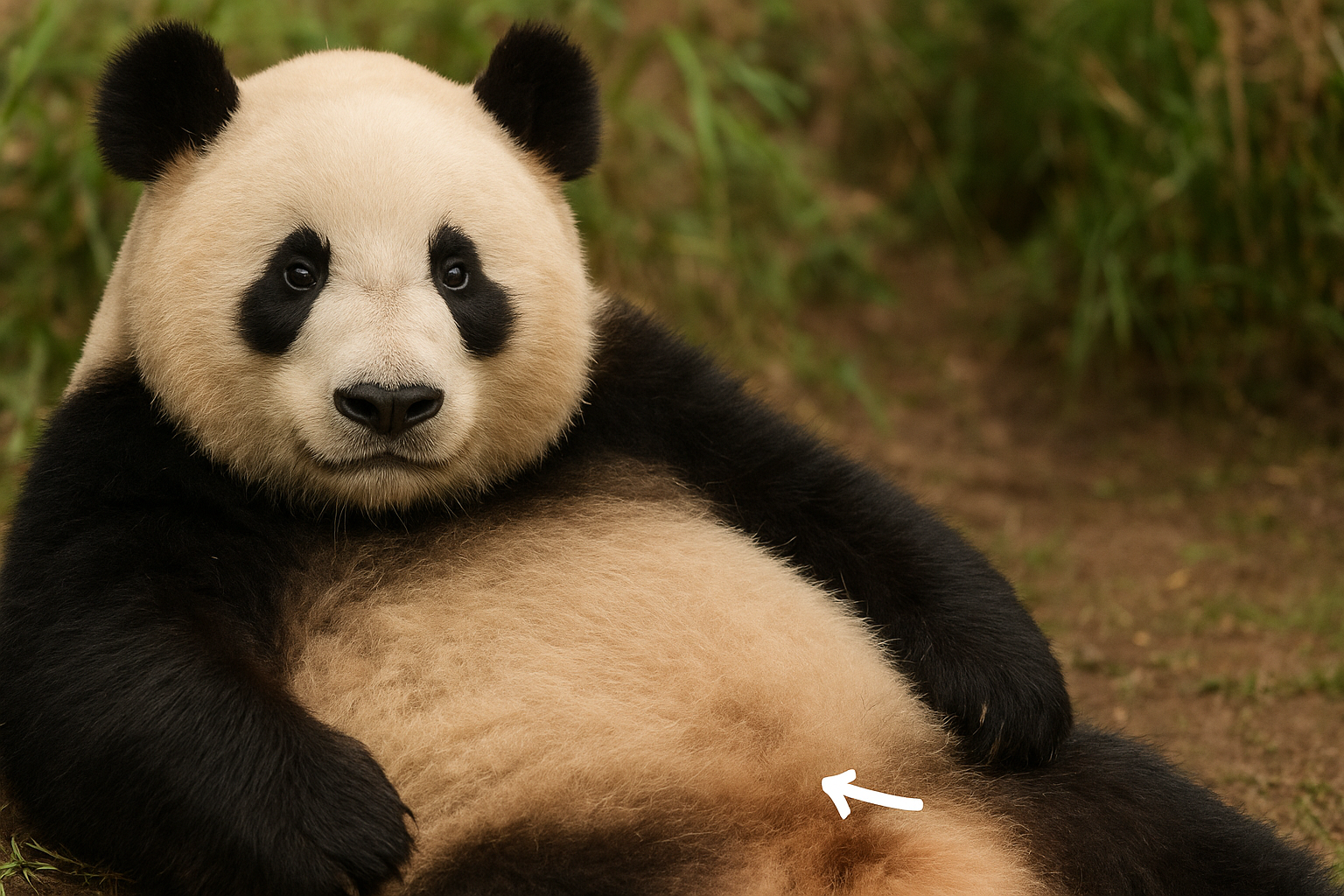
Yes, giant pandas have belly buttons. Just like every other mammal, these fascinating black and white bears also bear the small scar that testifies to their bond with their mother. Behind their thick, soft fur lies a tiny but crucial mark: the panda's navel.
Why even pandas have belly buttons
During gestation, the umbilical cord connects the panda fetus to the mother, allowing it to receive vital nutrients and oxygen inside the womb. As with humans, when the baby is born, the mother gently cuts the umbilical cord with the teeth, interrupting the flow and leaving a small wound which, once healed, becomes the navel. In the first days of life, the umbilical stump remains visible and measures just one or two centimeters. Afterwards, it comes off naturally leaving a tiny whitish scar: the point at which the physical bond with the mother ends.
Panda Birth: A Miracle of Fragility
I giant panda cubs They are among the smallest newborns in the animal kingdom in proportion to their mother's body: they weigh just 100-200 grams At birth, less than a chocolate bar. At this stage, the presence of the umbilical cord is essential for their survival. Immediately after birth, the mother licks and cleans thoroughly the baby, ensuring that the stump does not become infected and promoting natural healing of the umbilical area. This seemingly simple process is actually one of the most delicate moments of the maternal care of pandas, and marks the first step towards raising a healthy, strong puppy.
What does a giant panda's belly button look like?
Unlike the human navel, the panda's navel is very small and almost invisible. Measure on average 3 millimeters and is hidden under the thick white fur of the abdomen. Those who have had the opportunity to observe a panda up close—in research centers or during veterinary studies—describe the navel as a small spiral of hair which closes around a clear, barely perceptible mark. The fur that grows around the umbilical area creates a sort of natural curl, a small aesthetic detail that many never notice, but which tells the biological story of each panda.
A scar without function, but full of meaning
Once postnatal development is complete, The panda's navel no longer has any physiological function.
It simply remains as a biological trace of the maternal bond, the symbol of a birth and a vital connection now concluded. It is a natural reminder of how even a majestic and solitary animal like the giant panda is, ultimately, part of the same life cycle that unites all mammals.