






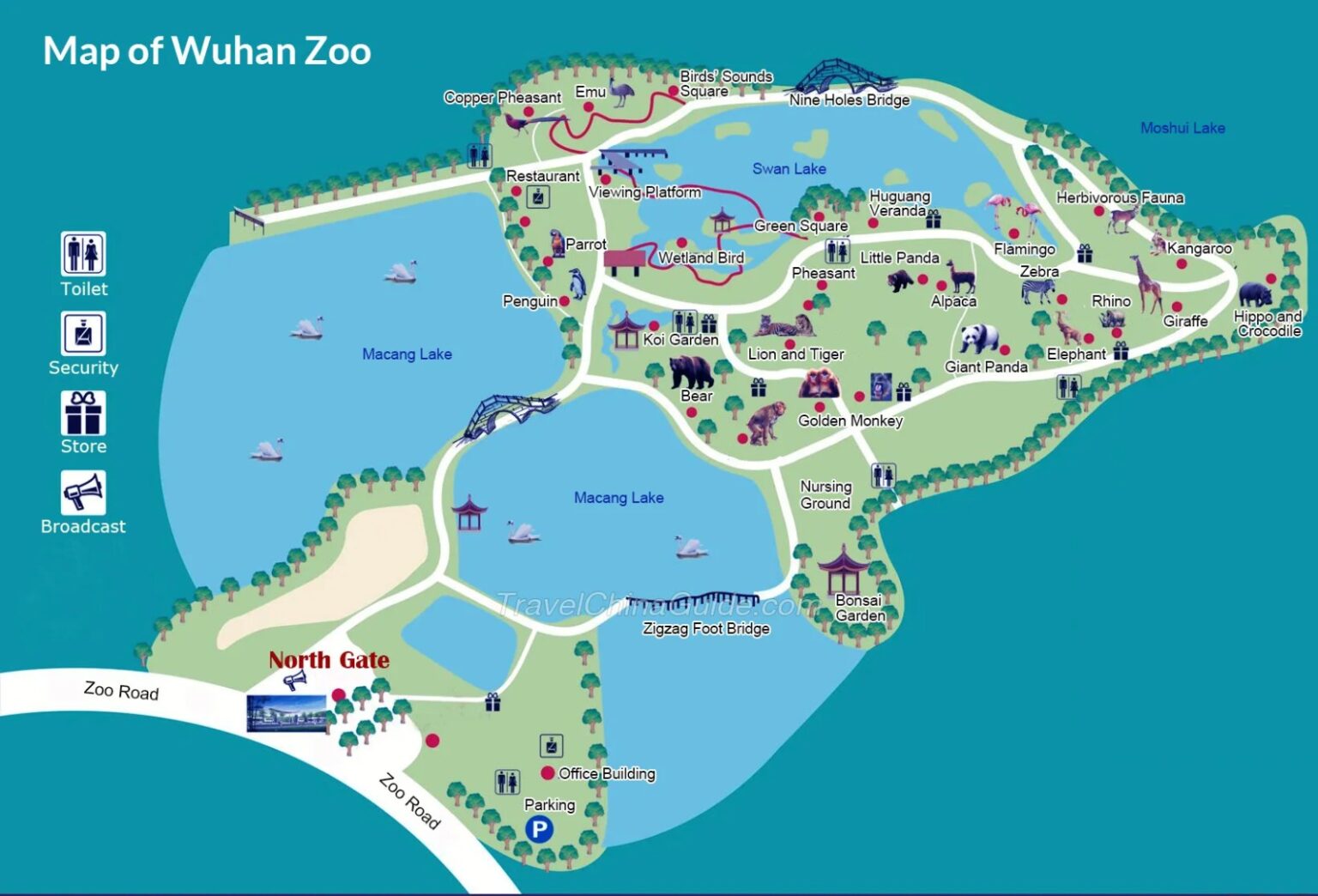
The history of Wuhan Zoo began in 1955 as the first modern zoo in Hubei. Wuhan Zoo, in fact, also became famous for a 2016 video, where a giant panda fought the 37°C summer temperatures by hugging a 10kg ice cube, becoming a Chinese anti-heat icon. In July 2019, the Giant Panda Hall (5400 sq m, RMB 100M investment). The sisters Chun Qiao (“Spring Bridge”, major, calm) and Pang Niu (“Fat Girl”, smaller, lively) were transferred from Sichuan to the well-known zoo and exhibited from July 26 in habitats simulating forests at 1500-3000m.
History of Giant Pandas at Wuhan Zoo: Who They Are
And then, the September 9, 2023, the real turning point has arrived that has thrilled all panda lovers in Wuhan. Imagine the scene. After years with only the two sisters Chun Qiao and Pang Niu, the zoo finally welcomes a mixed pair, Wulin e Mengmeng, shipped directly from the China Conservation and Research Center for the Giant Panda in Sichuan. Wulin He's the boy everyone adores. He was born on June 28, 2019, and his name means "Martial Hero of Wuhan," and it couldn't be more fitting. He's the kind of super-cute panda who spends his days awkwardly rolling around tree trunks, climbing everything, and doing somersaults that make children laugh. The nickname "playful" fits him perfectly.
His companion Mengmeng, on the other hand, was born on October 17, 2019, and is the opposite. Her name “Cute Dream” suits her perfectly. She is a shy female, the kind that hides behind the bamboo for a bit but then, when she feels comfortable, launches into epic feasts, devouring up to 20 kg of fresh bamboo a day. It is the first time in 7 years that Wuhan Zoo has had a male giant panda, and this has generated a really dynamic quartet For now no births on site, but the energy you can feel is that of a real birth center. ex situ breeding, where every detail is studied for genetics, public education and support of the 1864-1900 wild pandas plus 808 in captivity.
Giant Panda Hall: History, Design, Panda Personality, and Daily Care
Imagine getting closer to the Giant Panda Hall Wuhan Zoo and discover a magical world from three different perspectives. From ground level, where you're right up close to the action; from the suspension bridge that makes you feel like you're standing atop the Sichuan mountains; and from the observation tower, perfect for taking epic photos from above. Here, each panda has its own unique personality that instantly captivates you. Wulin, the tireless explorer, spends his days poking around everywhere. He climbs artificial rocks, dives into bushes, and seems to never stop, like a little furry Indiana Jones. Then there's Mengmeng, the queen of gastronomic relaxation. She's a shy dreamer who devours up to 20 kg of fresh bamboo a day—always the 6-7 tastiest varieties—which make up the 99% of her diet, nibbling on it with a calmness that makes you want to join her!
Chun Qiao Instead, she embodies pure elegance. You often see her resting gracefully on a branch, like a diva enjoying a well-deserved rest after a life of adventures. And then there's her, Pang Niu. The natural-born gambler who plays with huge logs, pushing them here and there and creating tragicomic scenes, making both adults and children laugh. Wuhan doesn't mess around with the stifling summer heat (up to 40°C!). Pandas fight the heat with 10-20 kg ice cubes They embrace like refreshing pillows, with powerful fans, automatic showers, and pools to splash around in. In winter, however, everything changes. Warm stoves and heated carpets recreate the warmth of the Sichuan forests, so they never feel cold.
The team of volunteers
Behind the scenes, a team of 10 highly specialized veterinarians watches over them 24 hours a day. Keepers monitor their weight (between 80 and 120 kg for adults), analyze their feces for digestive health, and subject the giant pandas to routine checks. Interactive panels along the route tell fascinating stories, such as seasonal reproduction (from March to May, with 1-2 puppies every two years, but a very high neonatal risk 50%), the deforestation which wiped the 96% of their original habitat, and the successes of the rewilding with 11 pandas reintroduced into the wild, 9 of which are still alive and wild. And as icing on the cake, right next door you'll find 6 red pandas very lively and the rare Chinese giant salamanders, which make you understand how precious the shared ecosystem of these creatures is.
Other must-see attractions and their role in global conservation
In addition to giant pandas, Wuhan Zoo It's a true paradise for animal lovers. A place where you can get lost among spectacular creatures that seem to have come straight out of a documentary. Just think of the giant Siberian tigers, majestic beasts that can weigh up to 300 kg. Seeing them stroll with feline power, roaring softly as they stretch out in the sun, it's immediately clear why they're among the zoo's stars.
Then there are the Asian elephants, with their trunks spraying water or tearing leaves, perfect for entertaining children who watch them open-mouthed. There is no shortage of white rhinos, as imposing as armored tanks grazing peacefully. Even 200 African lions. An entire proud colony that offers thrilling roars and simulated hunting matches in their large enclosures. And what about the koala sleepyheads, hanging from the branches like living stuffed animals, or gods 300 rare birds, from shocking pink flamingos to colorful parrots chattering among themselves. It's a variety that keeps you glued for hours, flitting from one continent to the next without moving a step.
In this way, Wuhan strengthens the “panda diplomacy” of Hubei, that Chinese soft power that uses pandas as ambassadors of peace and nature. And the location? It's a dream. The zoo is connected to the historic Yellow Crane Tower (UNESCO heritage, 20 minutes away) and the majestic Yangtze River, so you can transform your day into an irresistible mix of animals, ancient culture and river landscapes.
A comprehensive practical guide: tickets, transportation, timetables, and expert tips.
TicketsAdults: CNY 50 (~€6), children/seniors CNY 25; online via WeChat/Alipay for skip-the-line tickets. Hours: 8:30 am–5:00 pm (last admission 4:00 pm), closed Mondays; Panda Peak: 9:00 am–11:00 pm and 2:00 pm–4:00 pm.
Transportation: metro Line 1 Hankou Station + bus 510 (20 min, 2 CNY); taxi from Tianhe Airport (45 min, 150 CNY); Dazhi Road Main Gate. Parking CNY 10/hour.
Pro tipsArrive 8:30 a.m. for active morning pandas; route: Panda Hall → tigers → elephants → picnic lunch (picnic areas). Avoid 12-14 heat; no drones or large bags. WeChat Zoo app for maps/live cams.
Disabled: Full ramps; no pets. Combo with East Lake Cherry Blossom (spring) for a full day.
Why choose Wuhan Zoo for giant pandas and families?
Inside the Wuhan Zoo You can experience a unique panda adventure. Tickets are very cheap—just 50 CNY for adults, about 6 euros—and getting there is a breeze. Take Metro Line 1 to Hankou Station, then take bus 510, which takes 20 minutes, or a taxi from the airport, which takes 45 minutes. Accessibility makes this zoo a perfect ally for everyone, from families on vacation to solo travelers.
The premium experience
The history of Wuhan Zoo is really interesting as well as the experience premium to experience with their families, in the large international park. Giant pandas such as Wulin, Mengmeng, Chun Qiao and Pang Niu live in habitats spacious and natural, with plenty of space to roll around, climb, and bathe in the pools and man-made forests that look straight out of Sichuan. And then there's the diverse wildlife: Siberian tigers, elephants, lions, koalas; it's like a global safari in one place. Add to this the unique cultural context of Hubei, with the Yellow Crane Tower and the Yangtze River just a stone's throw away, for a day of nature, history, and adventure.
The families love it. Themed play areas with panda-shaped slides, shaded picnic areas and wide stroller-friendly paths, where children can run around happily after watching Wulin roll around. experts and enthusiasts, instead, they stop for hours in front of the panels that explain reproduction, genetics and deforestation. In central China, for those who love giant pandas, it is a absolute must.