






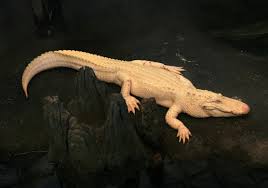
Claude is the albino crocodile who died at the age of 30 and was a unique animal who taught the world to look at nature with eyes full of wonder.
Claude, the albino crocodile beloved by the American community, has died.
There were few places in the world where you could feel the magic of nature like in front of the pool of Claude, the albino alligator of the California Academy of Sciences. His slow movements, pale skin, and red eyes captured the silence of visitors, transforming curiosity into amazement. Today, however, San Francisco mourns its most unusual ambassador: Claude is died at 30, after having lived a life which, for an alligator like him, is already a small miracle.
Farewell to Claude, the albino crocodile: the story
Claude was born in 1999 in Louisiana and was part of a small group: fewer than 200 known albino alligators in the world. Its extraordinary appearance was the result of a genetic mutation that prevents the production of melanin, making the skin extremely white and the eyes sensitive to light. In nature, this trait represents a curse: without the ability to camouflage itself or protect itself from the sun's rays, an albino animal has a hard time surviving.
For Claude, however, life took a different path. After a period in a Florida zoo, in 2008 he arrived at California Academy of Sciences, where he was welcomed as a true living treasure. Here he found care, safety, and a loving community. Children wrote him letters, tourists lined up to see him, and the museum even broadcast a livestream of his habitat, so everyone could continue to follow him even from afar.
An ambassador of biodiversity
Claude, the albino crocodile died at 30 years old and he was not only an attraction, but a ambassador of nature. Her distinct appearance taught millions that diversity is a strength, not a weakness. With her calm and uniqueness, she brought the public closer to the world of science and conservation, helping the museum demonstrate how fragile and precious natural balances are.
There California Academy of Sciences He recalled that Claude "brought joy and ecological awareness to millions of hearts," and announced a public memorial to celebrate his life. Even from a distance, anyone who saw him at least once will remember his majestic presence, a symbol of harmony between science and empathy.
Is albinism a disease?
Albinism is not a disease, but a rare genetic trait This deprives the body of melanin, the pigment that gives color to skin, scales, and feathers. This pigment protects against ultraviolet rays and supports vision. Its absence makes albino animals more vulnerable, both because they have difficulty camouflaging themselves and because they are more sensitive to light. In the natural world, such an individual has little chance of growing and reproducing. Claude, however, was able to live in safety, becoming a privileged witness to the relationship between human care, science and environmental respect.
Claude's Legacy
Claude's story reminds us that every difference is a window onto something extraordinary. His life, spent between the clear water of the tank and the wonder-filled gazes of visitors, is proof that knowledge can also be born from tenderness. Today, the world's most beloved albino alligator is no more, but his legacy lives on in the message he left behind.. Biodiversity is not just a scientific concept, it is a language of beauty and connection..