






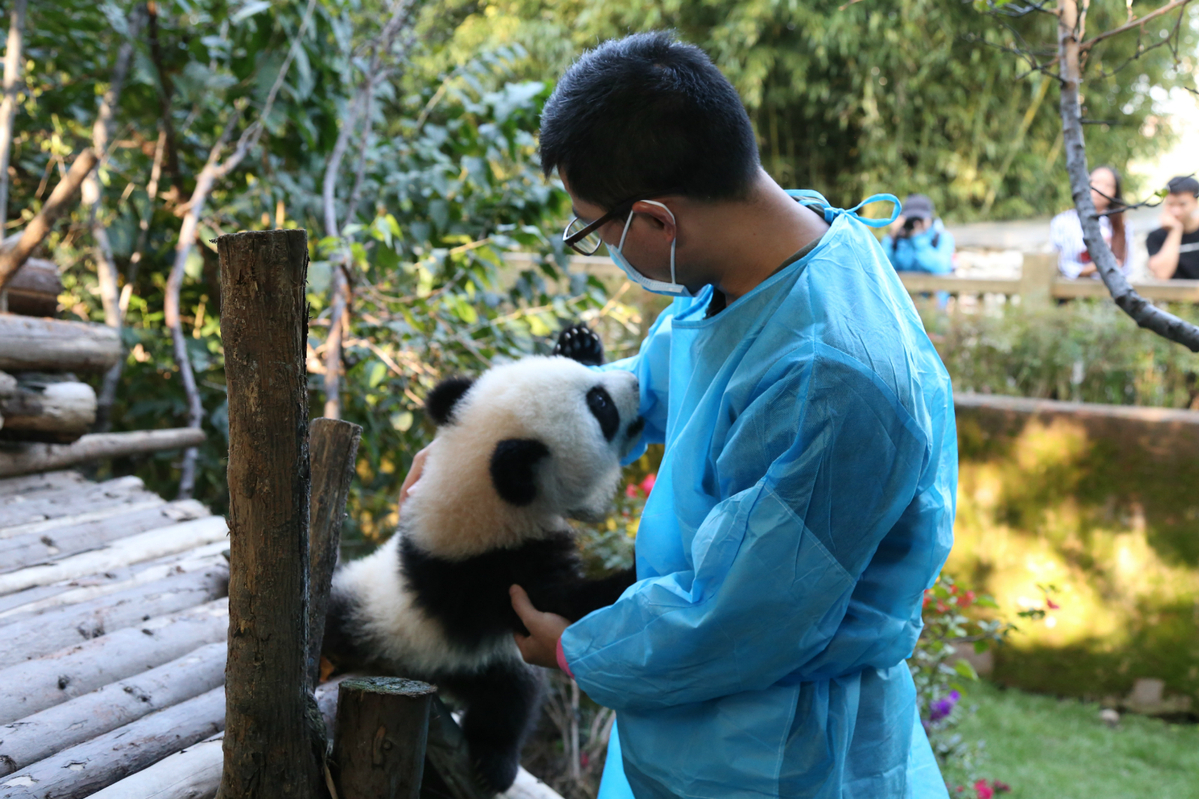
The health of giant pandas housed abroad depends on a rigorous system that combines partner selection, ongoing veterinary monitoring, and international scientific cooperation. Behind the endearing image of pandas living in zoos around the world lies a highly precise protection system, designed to ensure the well-being, safety, and conservation of the species.
Giant Pandas Abroad: Partner Selection
China carefully selects foreign institutions to house giant pandas abroad. Applicants must demonstrate high animal welfare standards, a good public reputation, and solid technical expertise. They must also provide adequate facilities, stable food availability, and a professional team capable of managing, breeding, disease prevention, and research. Before approval, institutions undergo a comprehensive assessment according to the guidelines for international giant panda cooperation. This step ensures that the host environment can truly provide suitable conditions for a fragile and highly specialized species like the giant panda.
Training and supervision
Before the giant pandas arrive in other countries, Chinese specialists train the host facility's technical staff and illustrate management, feeding, and emergency response protocols. The cooperation doesn't end with the shipment of the animals. It continues over time with constant and direct supervision. Throughout the collaboration period, the two parties appoint dedicated technical contacts and maintain regular communication. Host institutions are required to submit monthly, semiannual, and annual health reports to compile a complete medical record for each panda. This way, any clinical changes are monitored and immediately traceable.
Continuous veterinary checks
Health surveillance plays a central role. Chinese experts conduct monthly health reviews of the animals, while technical teams conduct annual on-site inspections. If significant problems arise, China sends teams of specialists who remain on-site for longer periods and support local staff in treating and controlling diseases. This approach allows for rapid intervention, risk reduction, and consistent management internationally. The logic is simple: prevention is more effective than cure, especially when dealing with a vulnerable species like the giant panda.
Shared scientific research
Cooperation extends beyond daily care, but also to research. Scientific programs are developed jointly by Chinese and international partners and focus on reproduction, cub rearing, disease prevention, and conservation genetics. The most important technical procedures require the approval of the Chinese partners, who participate in the process and share the results. This model pursues a specific goal: protecting the pandas' well-being with scientific methods and shared responsibility among institutions.
You may also be interested in:
Panda giganti, la Cina dice basta: divieto a vita per chi sputa, lancia oggetti o diffonde fake news
Transparency and information
Another key element is public communication. Updates on cooperation and the pandas' living conditions are disseminated rapidly through official channels. The Chinese side works with partner institutions to answer public questions and provide accurate, direct, and verifiable information. Transparency reduces the risk of misunderstanding and strengthens trust in international programs. In a context where giant pandas are attracting media attention and global affection, clear information becomes an integral part of conservation.
Why this model matters
The system adopted by China demonstrates that giant panda conservation abroad is not based solely on public displays of the animals, but on a structured set of rules, expertise, and monitoring. Each stage, from partner selection to final communication, contributes to protecting the animals' health and strengthening cooperation between countries. For the public, understanding this process helps them understand pandas not just as symbols of tenderness, but as protagonists of an international conservation model that requires responsibility, expertise, and continuity.