






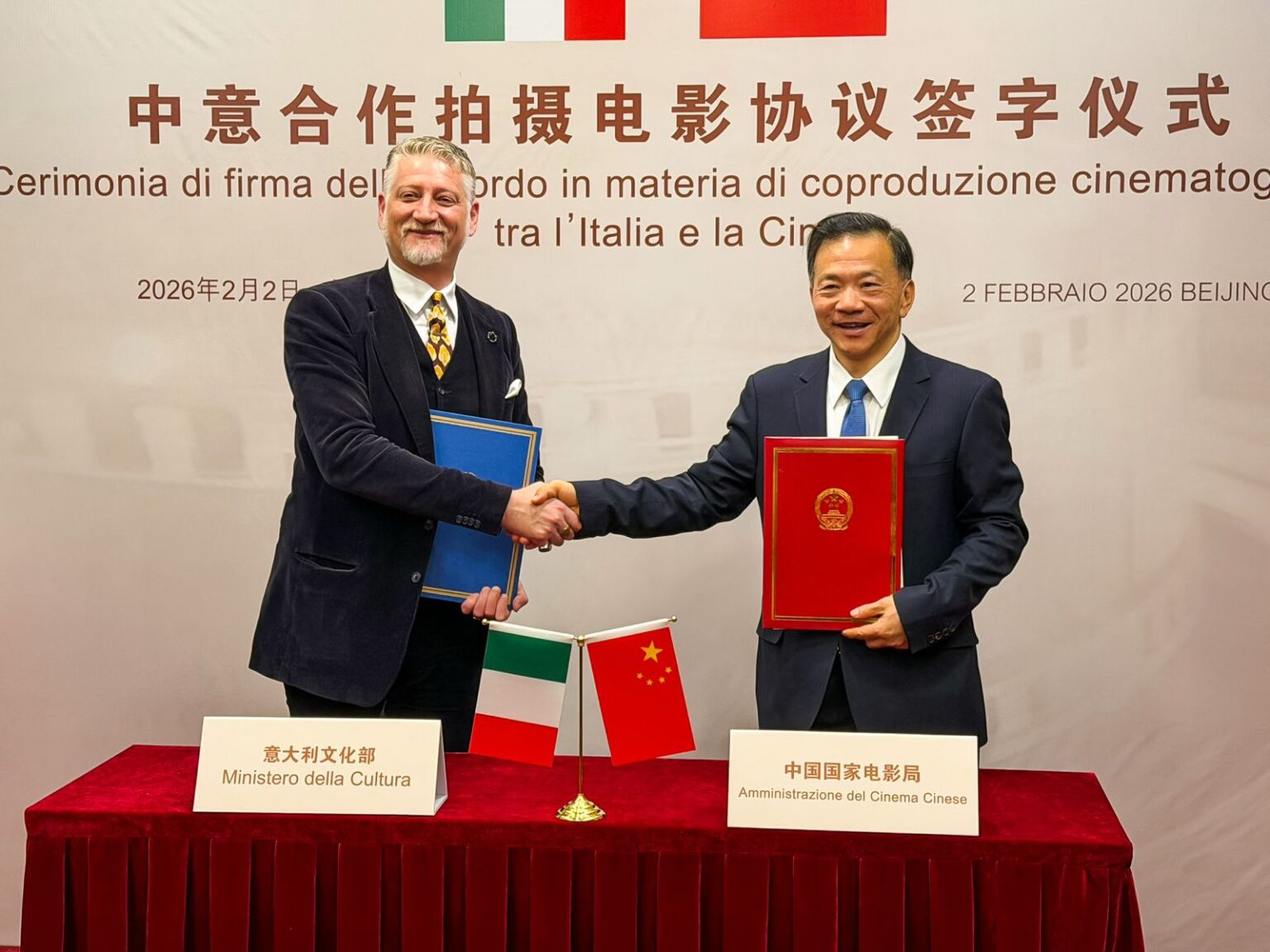
In Beijing, Minister Giuli and Shen Haixiong signed the new film co-production agreement between Italy and China. This will provide greater opportunities, funding, and visibility for the two countries' cinema.
Italy-China Film Co-production Agreement 2026: the agreement
On February 2, 2026, in Beijing, Shen Haixiong and Alessandro Giuli signed the "Agreement on Film Co-production between the Governments of the People's Republic of China and the Republic of Italy." The agreement was signed on behalf of the Chinese State Administration of Cinema and the Italian Ministry of Culture, establishing an updated institutional framework after several years of regulatory vacuum.
The new agreement is part of the Ministry of Culture's strategy to support the internationalization of the Italian film industry by promoting joint projects with one of the world's leading film industries. The stated goal is to enable Italian and Chinese filmmakers to collaborate more easily on joint projects, reducing bureaucratic obstacles and strengthening mutual support for the production and distribution of works.
Why is the 2026 Italy-China agreement strategic for cinema?
The previous bilateral co-production agreement between Italy and China expired in 2021, leaving the sector without an official instrument to support joint projects for several years. The 2026 protocol reestablishes this regulatory framework and provides new impetus to the internationalization of the Italian film industry.
The agreement comes at a time when international co-productions are considered crucial for accessing global markets, distributing works, and participating in festivals. For Italy, cooperation with China means engaging with a rapidly expanding market, from major digital platforms to theatrical circuits, while keeping creative talent and the national cultural heritage at the center.
What does the Italy-China co-production agreement provide?
The agreement includes a series of measures aimed at facilitating Italian-Chinese film co-production and strengthening synergies along the entire supply chain, from writing to distribution.
Among the key points:
- Joint film production between Italian and Chinese production companies, with official recognition as "co-production" by both governments.
- Structured collaboration between the film institutions of the two countries, with particular attention to the sharing of artistic, production, and technical resources.
- Promoting Italian cultural heritage in Chinese media, including through documentary projects.
- Synergies in the distribution of works in their respective markets, to increase the visibility of Italian cinema in China and of Chinese productions in Italy.
- Support for the organization of reviews, focus groups, and special programs at festivals, following initiatives such as “Italy–Country in Focus” and “Italian Screens.”.
According to Undersecretary of Culture Lucia Borgonzoni, the milestone reached in Beijing represents a further step forward along this path, towards a shared future founded on Italian creative talent.
Benefits for Italian film producers, authors, and professionals
For Italian audiovisual companies and professionals, the new Italy-China co-production agreement translates into a series of concrete benefits.
- Easier access to the Chinese film market, among the largest in the world in terms of number of theaters, admissions, and box office volumes.
- Greater financing opportunities and cost-sharing, thanks to the collaboration between funds, incentives, and production resources of the two countries.
- Opportunity to develop stories with a truly international scope, capable of speaking to both Italian and Chinese audiences, while simultaneously highlighting local identities and landscapes.
- Incentives for circulation at festivals and events, where co-productions are often perceived as projects with high cultural and market value.
- Strengthening professional skills through joint work between mixed crews, exchanges of technicians, authors, screenwriters, and talent.
For the viewer, this will translate into a greater offering of films that tell the story of the encounter between different cultures, languages, and sensibilities, but with high production standards and more widespread distribution.
The role of China Media Group and the Ministry of Culture
China Media Group, led by Shen Haixiong, is China's leading audiovisual production and digital platform group and plays a central role in the development strategy of China's film and audiovisual sector. The signing of the agreement with Minister Giuli confirms the Group's commitment to investing in co-productions that can reach a global audience, integrating Chinese industrial expertise with Italy's creative tradition.
The Italian Ministry of Culture, through its Directorate General for Cinema and Audiovisual, frames the agreement within a broader international promotion project for Italian cinema, which includes selective calls for proposals, tax incentives, and branding initiatives such as dedicated showcases at foreign festivals. In this context, the agreement with China becomes an operational tool for transforming cultural diplomacy into concrete projects and titles.
Future prospects for Italian-Chinese co-productions
In recent years, several co-productions between Italy and China have already experimented with forms of collaboration, especially in the historical and documentary fields, anticipating the potential now being relaunched at the institutional level. The new agreement offers the opportunity to consolidate these paths and open new ones, including in the most popular genres such as genre cinema, animation, and series for platforms.
The challenge for producers and writers will be to craft stories that speak to both cultures, avoiding simplifications and stereotypes, and making the most of the locations, talent, and technologies of both countries. If used well, the 2026 Italy-China Film Co-production Agreement could become a key element in the presence of Italian cinema on the global stage, contributing to the economic development of the sector and the dissemination of Italy's cultural image worldwide.