






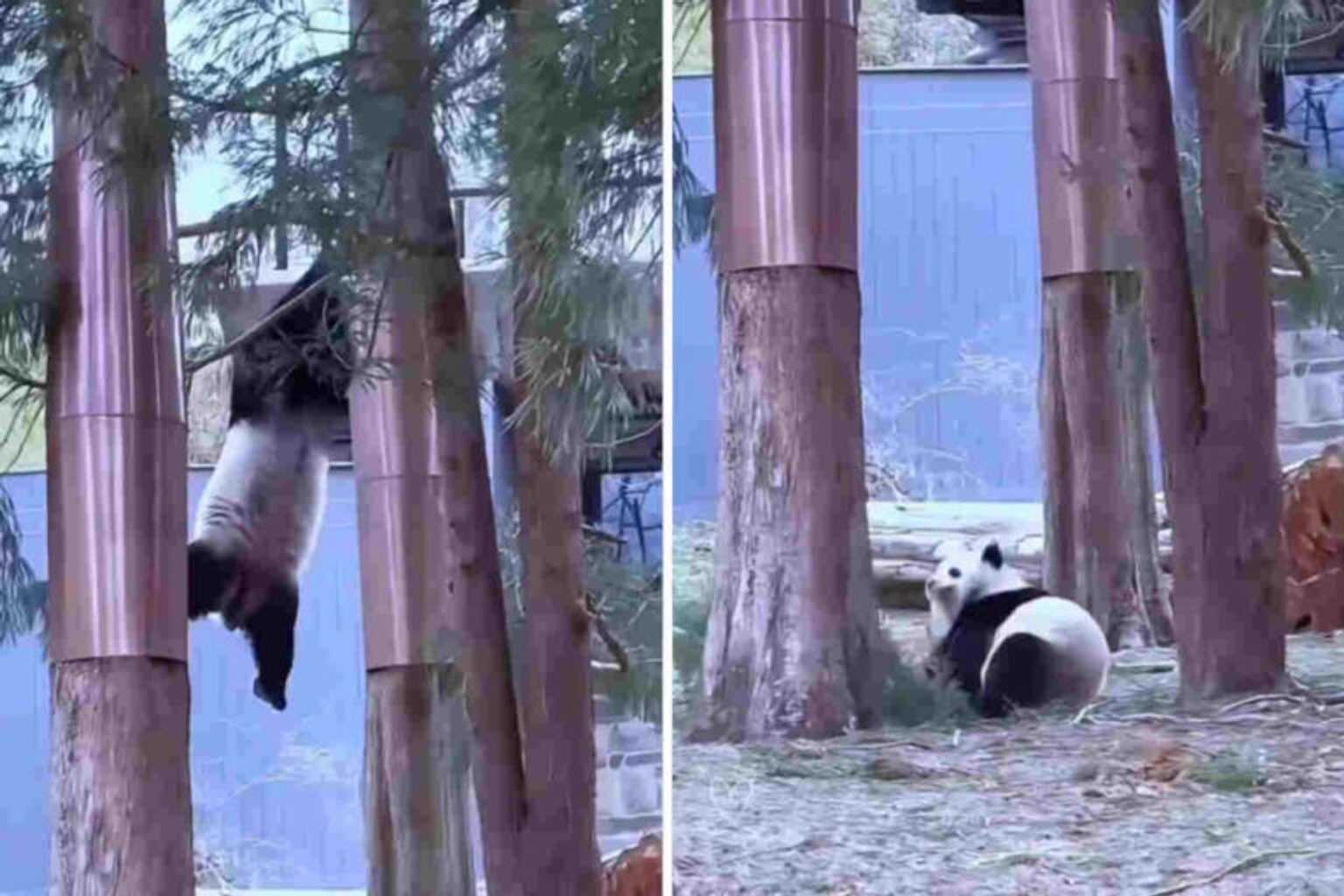
Giant pandas fall Often from trees—cubs play by climbing and sliding, adults test unstable branches—but rarely suffer serious injuries thanks to their thick fur and plump bodies that act as cushions. Viral videos from various centers and zoos around the world capture these comical moments, confirming that falls are a natural part of their exploratory and clumsy behavior. Discovering giant panda falls reveals their physical resilience, essential for survival in steep forests, and dispels myths about fatal accidents.
Why do giant pandas fall so often?
Giant pandas are inexperienced climbers. They spend hours in the trees for fun, like puppies, to rest or to escape, but their heavy bodies—between 80 and 150 kg for adults—and short legs make them rather clumsy. Cubs often fall during "play fighting," a behavior essential for motor and social development, as observed in studies conducted at the Chengdu Research Base. Adults also fall while testing unstable branches or during playful chases, especially in captivity with artificial trees. This is not pathological clumsiness, but an evolutionary adaptation. These short falls strengthen bones and coordination.
Anatomy that protects from wounds
Their thick fur, which can reach 10 cm, along with their rotund bodies, acts like a natural airbag. It absorbs impacts from heights of less than 20 meters without causing fractures. Their strong bones and subcutaneous fat distribute the force of impact evenly, making them virtually "fall-proof," even for jumps of up to 10-15 meters. Studies confirm this. Normal falls in puppies do not cause injury and contribute to the formation of reproductively competent adults.
Viral videos of giant panda falls
Compilations of giant panda falls have billions of views on social media because of their irresistible comedy.
- Toronto Zoo, in 2017: puppies roll down, confirming “falling is normal play”.
- Bei Bei, Smithsonian Zoo: he climbs, loses his balance, lands softly and continues playing.
- YuKe, Chongqing, in 2025: scary fall from tall tree, but unharmed – tree removed for safety.
These videos from Wolong show “bouncing” landings without damage.
Rare cases of injuries from falls
Serious injuries in giant pandas are rare. One documented case involved a wild panda in the Wolong Reserve in 2014, who died of an intracranial hemorrhage after falling on a wet slope during a landslide. No recent fatalities have been reported in captivity; minor scratches or bruises heal on their own without intervention. The main risk factors include extreme altitudes over 20 meters, rocky terrain, or adverse weather conditions typical of nature. Zoos prevent these dangers with secure enclosures and constantly monitored trees.
Behavior and prevention in zoos
Cubs fall 10-20 times a day during play, developing strength and motor skills. Adults, however, tend to avoid weak and unstable branches. Zookeepers intervene by cutting down dangerous trees after accidents (as in YuKe's case) and monitor them constantly with cameras. In the wild, steep forests amplify the risks, but the population remains stable at approximately 1,864-1,900 wild pandas, demonstrating their remarkable resilience.