






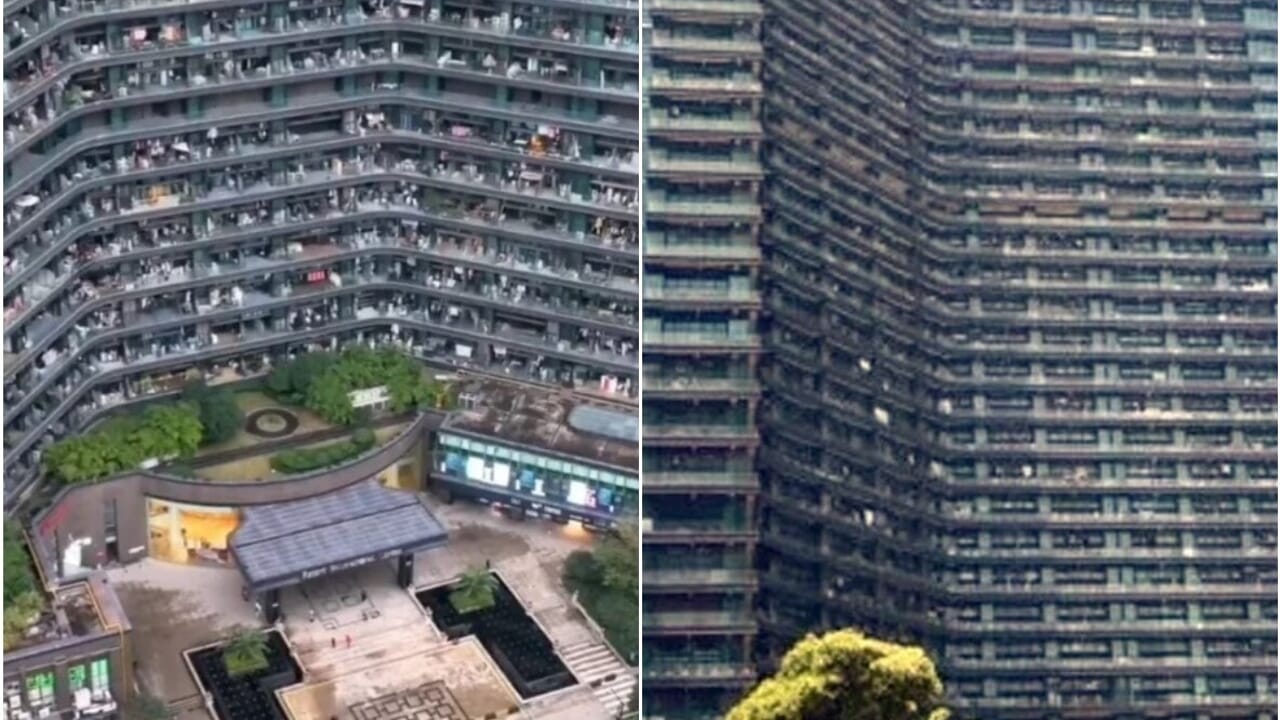
In China, a condominium complex has been built the size of an entire neighborhood. It houses approximately 20,000 people who live, work, and play without ever leaving the building. It's real, and it's located in China.
China, the largest condominium in the world, 20,000 people live here without ever leaving: the incredible structure
In the heart of the Qianjiang Century City , the most dynamic area of Hangzhou , an incredible condominium is rising. Regent International Apartment Complex, an S-shaped building nearly forty stories high, as long as several city blocks and large 260,000 square meters . It's one of the largest residential complexes ever built, housing the equivalent of a small Italian town's population. Videos posted on social media show a vertical city: lights, balconies, and a maze of corridors that open onto restaurants, schools, libraries, clinics, and fitness centers. A closed ecosystem, where every need is met within the same building.
A city within four walls
The project, signed by the architect Alicia Loo , born as a luxury hotel and was later converted into a self-sufficient residential complex. Today it houses approximately 5,000 apartments , from micro-apartments for students and workers to luxury solutions with panoramic views and private terraces.
Rents range from 500 RMB per month (about 190 euros) for the most modest units up to 4,000 RMB (over 500 euros) for those located on the upper floors. The lower levels of the building are entirely dedicated to commercial activities, while the upper floors offer comfort, privacy, and social status.
The complex is also partially sustainable: it uses photovoltaic systems , water recycling systems and an internal organization designed to reduce travel. Everything is within easy reach, even an Olympic-sized swimming pool and basic medical services.
The social experiment
The autonomy of the condominium in China that houses 20,000 people, the Regent International However, it raises profound doubts. If for some it represents the symbol of urban modernity, for others it is a disturbing microcosm , where life unfolds without contact with the outside world. Those who live there have everything, but often end up never leaving. Social interaction is limited to corridors and common areas, and the line between comfort and confinement becomes blurred. Many people reveal this as a "“ luxury cage ”, an aseptic world where time seems to flow differently from the rest of the city.
The other side of the coin
The case of the Regent International It is more than an architectural curiosity; it is a reflection on the future of living . In an age where cities are becoming increasingly dense and digital, this experience reveals the human cost of forgoing contact with the outside world. Beneath the apparent efficiency lies a social experiment that replicates the same inequalities as in the real world. Those who move up a floor gain space, light, and privileges. The dream of total self-sufficiency, perhaps, comes at a price: that of freedom.