






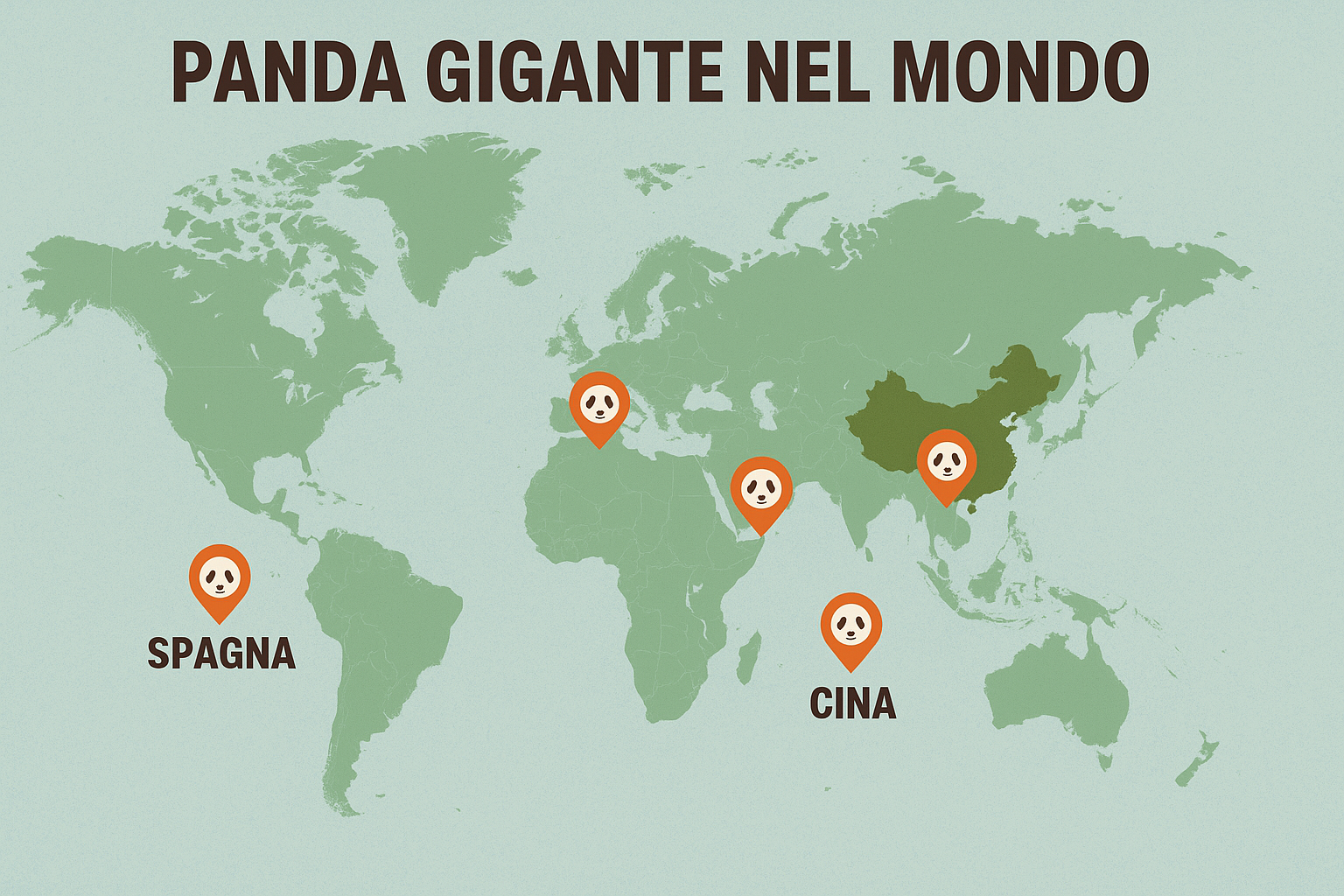
China, through the Panda Base, has established the “Giant Panda Long-term International Cooperative Breeding Program” with several countries, promoting scientific and diplomatic exchanges. As of 2023, 25 births with 37 cubs have been recorded. giant panda in these international programs. Let's take a closer look at the zoos that house this beautiful protected species.
The giant panda, a symbol of friendship: international zoos that host the protected species
The international zoos which host the giant panda in Europe and the rest of the world and, consequently, have joined the species conservation project are the following:
The giant panda and zoos in Europe
- Madrid Zoo, Spain: The cooperation began in 2007. The historic couple Bing Xing and Hua Zuiba returned to China in February 2024. Starting in April 2024, the zoo welcomed a new couple: Jin Xi (born 2020 in Chengdu) and Zhu Yu (born 2020 in Chengdu).
- ZooParc de Beauval, France: the couple Yuan Zi (male) and Huan Huan (female) arrived in 2012, after five years of negotiations. They had three puppies in two litter sizes. Yuan Meng, the first giant panda born in France, returned to China in July 2023 and Yuandudu e Huanlili (female twins).
- Berlin Zoo, Germany: The cooperation started in 2017. The resident pandas are Meng Meng e Jiao Qing. In 2019, Meng Meng gave birth to twin cubs.
- Copenhagen Zoo, Denmark: The joint project was launched in 2019. The pandas are Xing Er e Mao Er.
- The Ouwehands Dierenpark Rhenen, Netherlands: In 2015, during the official visit of King Willem-Alexander and Queen Máxima to China, the Netherlands and China established a partnership to protect the giant panda. In the presence of Xi Jinping and the Dutch monarch, an agreement was signed between the Ouwehands Zoo in Rhenen and the Chinese Wildlife Conservation Association. Once the new "Pandasia" area is completed, pandas Wu Wen and Xing Ya will be transferred to the Netherlands.
- Pairi Daiza, Belgium: host the couple Hao Hao e Xing Hui since February 2014. Two puppies were born later.
- Tiergarten Schönbrunn, Austria: In the 1990s, Austria expressed interest in housing giant pandas, and after years of diplomatic contacts, Yang Yang and Long Hui arrived at Schönbrunn Zoo in 2003, on loan from China. The pair had five cubs, but Long Hui died in 2016. A new male, Yuan Yuan, was introduced in 2019. After their return to China in September 2024, Vienna welcomed a new pair of pandas to a renovated enclosure in April 2025. Lan Yun (female), He Feng (male). In the past, the zoo has hosted cubs called Fu Long, Fu Hu e Fu Bao.
Asia and the rest of the world
The giant panda is present in several zoos in Asia and beyond. America, Australia, Qatar, and others have also shown strong interest in this magnificent species:
- In China, of course, the most important is the Chengdu Research Base for the Giant Panda Breeding, founded in 1987: As the world's largest conservation and breeding center, it hosts a population of over 260 giant pandas. Providing a complete list of their names is impossible, given their large and ever-changing population.
- Beijing Zoo, Beijing Zoo: The zoo is home to 11 giant pandas. Among the most famous are: Fei Yun, Meng Lan, Meng Da, Meng Er e Bai Tian. Meng Lan (known as the “Kung Fu Panda” for his escape attempts), Meng Er e Meng Da. IIn the past it hosted the famous Gu Gu. Beijing Zoo began housing giant pandas in the 1950s and received its first panda as a gift, Ping Ping, In the 1955. The “panda diplomacy” program formally began in the 1950s. .The panda Ya Ya, born at the zoo in 2000, returned there in 2023 after a 20-year stint at the Memphis Zoo.
- Atlanta Zoo, United States: The partnership with Panda Base began in 1999. The couple Mon Mon e Yang Yang She was at the heart of the program, giving birth to seven cubs in five litter sizes, a remarkable achievement in cooperation with the US and Europe. Lun Lun, Yang Yang, and their remaining twins returned to China in mid-October 2024.
- San Diego Zoo, United States: historic collaboration began in 1996. In June 2024, the zoo welcomed the new arrivals Yun Chuan (male of almost five years old) and Xin Bao (female, almost four years old). Xin Bao means “new treasure of prosperity and abundance,” while Yun Chuan is named in honor of her grandmother, Bai Yun (who lived in San Diego for 23 years).
- Smithsonian's National Zoological Park (Washington, DC): The zoo is home to two giant pandas who arrived in October 2024 and were introduced to the public in January 2025. Their names are: Bao Li (male, whose name means “active and vital power”) and Qing Bao (female, whose name means “green” and “treasure”). The tradition of pandas in this zoo dates back to 1972, when the first pair arrived as a gift after President Nixon's visit to China.
- Everland Resort, South Korea: home of the famous couple Ai Bao (female) and Le Bao (male). Ai Bao and Le Bao arrived in 2016 as a symbol of friendship between China and South Korea.
- Moscow Zoo (Russia): The Moscow Zoo is one of the centers that house pandas.
- Adelaide Zoo (Australia): It is the only place in the Southern Hemisphere home to giant pandas. It currently hosts a pair consisting of male Xing Qiu and female Yi Lan, who arrived in December 2024 and were introduced to the public in 2005, replacing the previous public favorites, Wang Wang and Fu Ni. Xing Qiu (male, name meaning “autumn star”), arrived in 2009. Yi Lan (female, name meaning “idle bliss”).
- Ocean Park (Hong Kong): The pandas An An e Jia Jia were donated in 1999. The couple Ying Ying e The The arrived in 2007 .A new couple, An An e Ke Ke, arrived on September 26th 2024 .The first pandas ever to be born in the park, Bao Ling and Bao Li, arrived on loan in 1977. This park has the largest population of giant pandas outside mainland China, with a total of six individuals. In addition to the pair Ying Ying and Le Le (a historic pair), it is home tothe first twins born in Hong Kong,Jia Jia e From From and another pair received from Beijing in September 2024.
- Shanghai Wild Animal Park: Qi Qi (female, meaning "Seven Seven"). This large urban zoo houses both giant and red pandas in a dedicated exhibit. The Panda House is one of the main attractions, with indoor and outdoor areas designed for the animals' well-being. The population is mixed.
- Adventure World (Japan): It is part of the centers that collaborate on panda conservation. Breeding collaboration with China began in 1994, when the first two pandas arrived from the Chengdu Research Base.
- Mandai River Wonders (Singapore): Formerly known as River Safari, it is home to giant pandas. The couple Kai Kai and Jia Jia arrived in 2012. Their first cub, Le Le, was born in Singapore in 2021.
- Zoo Negara (Malaysia): The National Zoo of Malaysia is participating in the program. The pair consists of Xing Xing e Liang Liang arrived in 2014, on the occasion of the 40th anniversary of diplomatic relations between China and Malaysia.
- Chapultepec Zoo (Mexico): The Mexico City Zoo is one of the historic participants in the conservation program.
- Dalian Forest Zoo, China: Fei Yun (female).
- Panda House, Qatar: arrival of the couple Thuraya (Sihai) and Suhail (Jingjing) in 2022, on the occasion of the World Cup, marking the first presence of pandas in the Middle East.
- Anji Bamboo World:
- Anyang Zoo: Municipal zoo in Henan province that houses pandas on loan from major research centers. It currently hosts Zhi Chun. It has previously hosted a panda named Of Of.
- Baoxing Education Center: Education and Cultural Promotion Center located in Baoxing, the county from which 17 of the 24 pandas sent as state gifts between 1957 and 1982 came. .Its purpose is to celebrate the history of panda discovery and conservation in this region. It is not a zoo, but an educational center. It does not house a stable captive panda population.
- CCRCGP Dujiangyan Panda Base: Also known as "Panda Ark," this base specializes in panda rescue, disease prevention, and rehabilitation. It is the only facility currently offering a volunteer program open to the public. It houses a mixed population of pandas of various ages for rehabilitation and research. Specific names are not listed due to the dynamic nature of the facility.
- Wolong Nature Reserve (Shenshuping Base): born in 1963 and is one of the China's largest and most important nature reserves. It was established in 1963 and is today part of the UNESCO World Heritage. Its history is the result of an environmental crisis, a courageous political choice, and decades of scientific work that have rewritten the future of the giant panda. It includes both the Wolong Geng Da Base and the Wolong He Tao Ping Base, but they have slightly different roles and structures within the conservation complex. CCRCGP Wolong Geng Da BaseRebuilt after the 2008 earthquake, it is the world's largest research and breeding base. Located in the Wolong Nature Reserve, it is home to over 30 pandas and is famous for having many cubs. It is the heart of the global conservation program. Given the huge population, it is not possible to list all the names. It is the center from which many of the pandas loaned internationally originate. CCRCGP Wolong He Tao Ping Base: The first-ever panda conservation base. Damaged by the 2008 earthquake, it now serves primarily as a specialized training center for pandas destined for reintroduction into the wild. It is not fully open to tourists. It houses pandas undergoing training for the wild. Training has been carried out here. Ying Xue e Ba Xi before their release.
- CCRCGP Ya'an Base: founded in 2003, it is a large breeding, research and education center that is home to over 40 pandas .It also serves as a quarantine center and residence for many pandas returning to China after international loans. It has hosted pandas returning from abroad such as Bei Bei, Tian Tian (from the USA) and Xiang Xiang (from Japan).
- Changsha Ecological ZooA zoo in Hunan Province. It holds the largest collection of pandas (four individuals) in south-central China, housed for educational purposes. The specific names of the four pandas currently housed are not available from available research.
- Chengdu Zoo: The facility is home to over 10 giant pandas and the city zoo, which is an alternative to the Research Base for seeing pandas, although with fewer specimens.
- Chimelong Safari Park (in Guangzhou)The facility is home to over 14 giant pandas and a large private safari park that is home to one of the largest panda populations outside of state research centers, including a family with twins born in the park.
- Chongqing Zoo: The facility is home to over 20 pandas and is one of the zoos with the largest panda populations in China. It is famous for housing the twins Yu Ke e Yu Ai and another set of twins nicknamed “Sixiwanzi” (four joys meatballs).
- Dafeng Zoo, a zoo in Jiangsu Province: Yun Er e Zhen Sheng They are the couple who host a pair of giant pandas relocated from the city of Yangzhou.
- Shaanxi Rare Wild Animal Breeding Center Louguantai: The Center was founded in 1987 to protect rare species of Qinling. It breeds giant pandas (including Qi Zai), crested ibises, golden monkeys and takin on 140 hectares.
- Foping Panda Valley: Pandas in training for reintroduction. This isn't a traditional zoo, but a rehabilitation center in the Foping Nature Reserve (Qinling Mountains) to train pandas to return to the wild. .
- Qinling Giant Panda Research Center: The kingdom of Qi Zai. Nestled in the Qinling Mountains west of Xi'an, the famous Qinling Giant Panda Research Center (part of the Qinling Four Rare Animals Science Park) is home to over 30 giant pandas. Open since 2014, the facility combines advanced research with ethical tourism, attracting millions for close encounters. Here are some 49 panda In captivity. It is the main research and breeding center for the Qinling panda subspecies, which is physically distinct from the Sichuan pandas. In 2023, the center welcomed seven new cubs, including two sets of twins born to the pandas. Zheng Zheng, An An e Ming Ming.
- Fuzhou Panda World and Fuzhou Research Center: A research and conservation center in Fuzhou that houses both giant and red pandas, with a focus on public education and a mixed population.
- Guangzhou Zoo: a historic zoo that has housed pandas since the 1960s. It welcomed male twins Jiujiu and Youyou, born in Madrid and returned to China, in September 2025 to a new facility.
- Guilin Seven Star Park Zoo: A zoo located within a famous park in Guilin. It houses pandas, but specific details have not emerged.
- Guizhou Forest Wild Animal Park: Wildlife park in Guizhou province that houses giant pandas as part of its wildlife collection.
- Hangzhou Safari Park: safari park in Zhejiang province that includes giant pandas among its main attractions.
- Hangzhou ZooHangzhou Municipal Zoo, which houses pandas on loan.
- Jinan Zoo: Municipal Zoo in Shandong Province.
- Jinbao Paradise: theme park that includes an area dedicated to pandas.
- Langzhong Panda Paradise: theme park dedicated specifically to pandas.
- Lanzhou Zoo: zoo in Gansu province that houses pandas.
- Linyi Botanical Garden: botanical garden which includes wildlife areas with pandas.
- Liugongdao Park: national park on Liugongdao Island that has hosted pandas in the past.
- Liuzhou Zoo: Zoo in Guangxi Province. It received male pandas Ming Bang and Shu Lin from Chengdu in March 2013. Ming Bang was born in Japan (Adventure World, Shirahama) in 2006 and returned to China in 2012, becoming a local celebrity.
- Mount Emei Xianzhi Zhujian Ecological ParkA tea-themed ecological park near Mount Emei that houses a "Panda Hall." It received pandas. Min Min, Ge Ge e Zhen Zhen in 2012. Later, Ge Ge and Zhen Zhen were exchanged with Bai Xue (a female rescued from the wild in 1993) and Pan Pan.
- Nanchang Zoo: zoo in Jiangxi Province. Its current resident is the male Mei Ling, who celebrated his 20th birthday in August 2024. . It has previously hosted a panda named Xi Meng.
- Nanjing Hongshan Forest ZooNanjing Forest Zoo. Its three pandas, He He, Ping Ping, Jiu Jiu, are among the main attractions and the “Panda House” is one of the most visited areas.
- Ningbo Youngor Zoo: a zoo in Zhejiang Province. In addition to its current residents, it once housed pandas. You You e Han Yuan. From their union were born Jia Jia e Zheng Zheng A 2015 photo shows panda Zheng Zheng
- Parque de Seac Pai Van (Macau SAR): giant pandas Kai Kai, Xin Xin They arrived in 2010. From their union, were born Jian Jian, Kang Kang, in 2015.
- Qingdao Zoo: Municipal Zoo in Shandong Province. It houses two giant pandas on loan from the Chengdu Research Base: the male Le Shui, who arrived in 2015, and the female Bei Bei, who arrived in 2014.
- Sanjiang Ecological Tourism ZoneThis is not a zoo, but an ecotourism area within the Wolong Nature Reserve, known for having one of the highest densities of wild pandas. The project here focuses on sustainable tourism to protect the pandas' natural habitat. The population is wild.
- Shenzhen Safari Park: A wildlife park that features a pair of giant pandas as one of its main attractions. The environment is designed to mimic their natural habitat, and the pandas are a major draw for visitors. .
- Shijiazhuang ZooA municipal zoo in Hebei province is housing giant pandas on loan, but specific details about the names of the specimens have not emerged.
- Siberian Tiger ParkLocated in Changchun, Jilin Province, this park is famous for its Siberian tigers but is also home to other species. In December 2015, it welcomed a pair of giant pandas, offering them a snowy environment to live in.
- Taman Safari Indonesia, Indonesia: Cai Tao and Hu Chun arrived from China in 2017. The couple came on loan from China and live in the “Istana Panda” (Panda Palace) and hgave birth to the first panda cub. There is a dedicated facility there at about 1,800 meters above sea level.
- Taihu Everglade Park: national park centered on a wetland ecosystem.
- Taiyuan Zoo: Municipal Zoo in Shanxi Province. It is home to two male pandas, Gonggong and Shunshun, born in 2013 and transferred here in 2015 from the research center .In 2016, the zoo was at the center of controversy after Shunshun the panda was photographed eating garbage thrown by visitors in his enclosure, prompting management to improve surveillance. Previously, in 2013, The zoo had received the pair formed by the male Cai Tao and the female Hu Chun, both born in 2010. For their arrival, the zoo had renovated its panda facilities. It is not clear from sources whether this pair was replaced by the next one or transferred elsewhere.
- Taipei Zoo (Taiwan): The couple arrived in 2008. Tuan Tuan (died 2022) and Yuan Yuan. From their union was born YuanBao.
- Tianjin Fude Zoo: Another zoo in Tianjin Municipality.
- Tianjin ZooXi Le arrived at the zoo this year. The Panda House was renovated and reopened in January 2024. The zoo previously housed a panda named Rong. The first one arrived in 2015.
- Tianmuhu Garden: botanical garden in Jiangsu province that is home to a group of four giant pandas: Yun Yun, Ao Yun, Xing An, Hua Li.
- Wenling Changyu Dongtian Scenic Spot: a tourist area in Zhejiang province that, in addition to its caves and rock formations, is home to a pair of giant pandas: Huan Huan e Xao Xin.
- Wenzhou Zoo: Municipal Zoo in Zhejiang Province.
- Wuhan Zoo: large urban zoo in Hubei province.
- Wuxi Zoo: zoo and amusement park in Jiangsu Province.
- Xiazhuhu National Everglade Park: national wetland park.
- Xiuning Giant Panda Ecological Park: ecological park dedicated to pandas.
- Xixiakou Wild Animal Park: large wildlife park in Shandong province.
- Yangzhou Zoo: municipal zoo in Jiangsu Province.
- Zibo Yunshan National Forest Park: national forest park that is home to pandas.
- Ueno Zoo, Japan: Ri Ri, Shin Shin, Xiao Xiao, She She arrived in 1972. The zoo received the first pandas in Japan, Kan Kan and Ran Ran. The current pair arrived in 2011.
What is Panda Village: a model of ecological conservation?
Where to See Giant Pandas in China: An Updated Guide to the Best Centers and Zoos
Sichuan, China inaugurates new research base for giant pandas
When to see giant pandas? The best season to admire them
Why do panda cubs need to be returned to China?
Giant Panda Sanctuaries Turn 20
The giant panda and zoos, social media stars: the most popular pandas
Global interest in pandas is amplified by the popularity of certain individuals who have become true cultural icons. Indeed, the presence of the giant panda in zoos in Europe and around the world has contributed significantly to their conservation.
Fu Bao: The South Korean Idol
Fu Bao Fu Bao is a female giant panda born on July 20, 2020, at the Everland Resort in South Korea. She was the first giant panda born in the country, the daughter of Ai Bao and Le Bao. Her fame exploded thanks to her playful appearance and special bond with her keeper, Kang Cheol-won. Her videos have reached approximately 500 million views on YouTube. Due to international agreements, Fu Bao returned to China on April 3, 2024, to contribute to the species' breeding programs, and was transferred to the Giant Panda Research and Conservation Center in Shenshuping, Sichuan.
Hua Hua: The Director's Fascinating Clumsiness
Hua Hua, born on July 4, 2020 at the Chengdu Research Base, is another celebrity. Daughter of Cheng Gong and Mei Lan, she stands out for her asymmetrical black shoulder patches and a "round and awkward" build. Her slow, unsteady walk has aroused great affection, contributing to the rise of tourism in Chengdu.
Qizai: the panda with the brown and white fur
Qizai (“Seventh Child”) is not an ordinary panda. He is the only one giant panda with a white and brown coat Raised in captivity, it was found only in 2009 in the Qinling Mountains. This rare coloration, sighted only seven times in history, is caused by a genetic mutation in a missing sequence of the gene Kiss2. Despite being bullied at a young age, Qizai is now a celebrity living peacefully in the Foping Nature Reserve in the Qinling Mountains.
Conservation, challenges and threats: protecting the habitat
Conservation efforts have yielded significant results, but threats to the Giant Panda persist:
- Habitat loss and fragmentation: The main reason for the historical decline has been the reduction and fragmentation of habitats, due to the expansion of the human population, cultivation, and the construction of roads and urban settlements.
- Bamboo addiction: The panda's diet consists almost entirely (99%) of bamboo, of which an adult can consume about 20 kg per day (up to 40 kg). The synchronous flowering of bamboo, combined with habitat fragmentation, can lead to severe food shortages in isolated populations.
- Ecological competition and diseases: New threats include competition for bamboo shoots with other species, such as takin and wild boars, which are also disease vectors.
Continued conservation requires an integrated effort, focused on restoring the ecological environment in natural habitats and developing public education programs, such as those promoted by Panda Base, to raise awareness of the importance of biodiversity. China attaches great importance to panda conservation, investing significant resources and supporting genetic research, disease prevention, and successful breeding, thus helping to ensure a brighter future for this iconic species.