






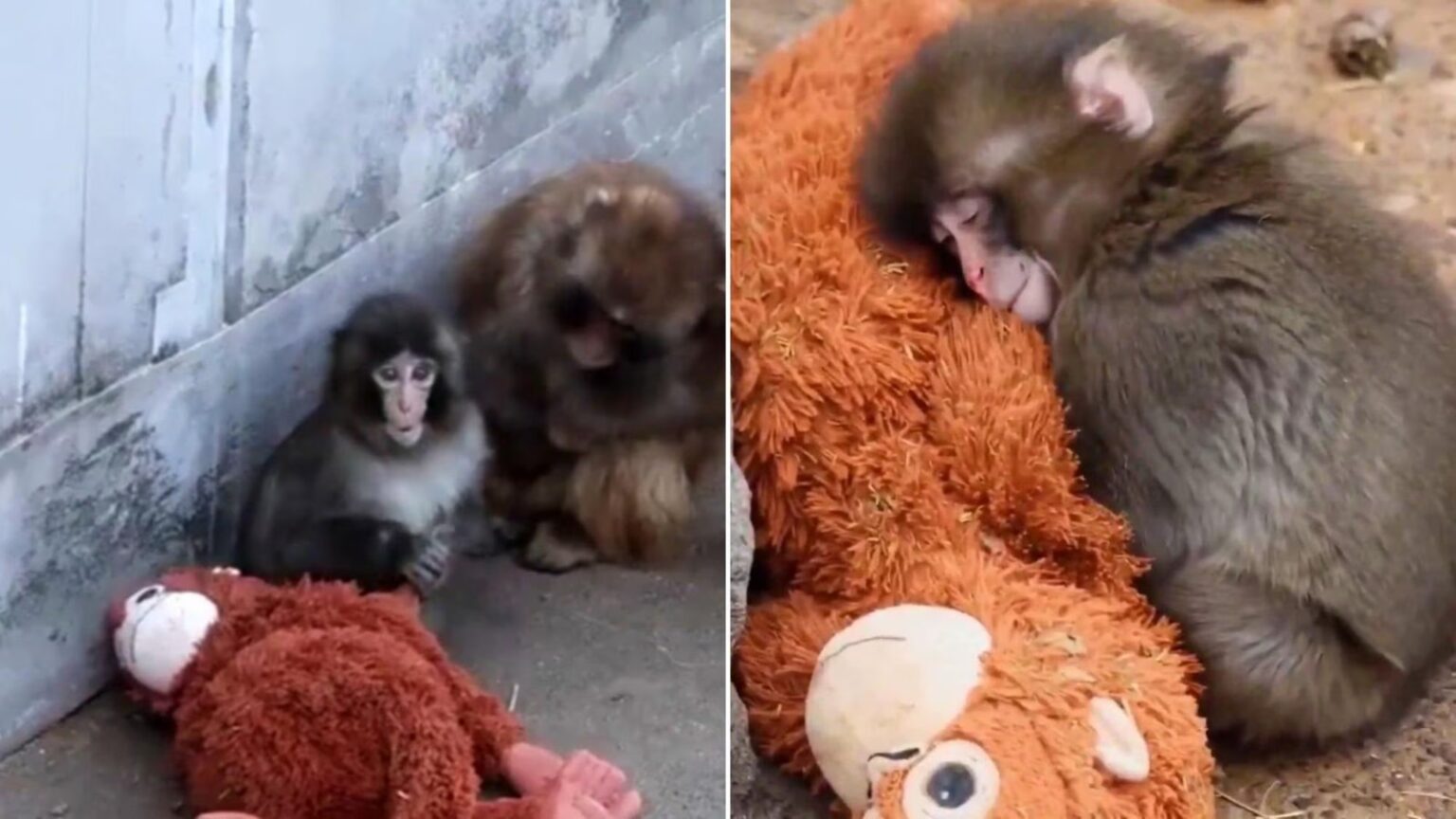
Why does the story of Punch, the little abandoned macaque who never leaves his stuffed animal, break our hearts and inevitably move us? Probably because, at least once in our lives, we've felt exactly like the little abandoned macaque, sad and alone. Rejected for no apparent reason. And, even, defenseless. When all we want is to have someone by our side, without filters. We just want to be loved unconditionally.
Punch, the abandoned macaque who never lets go of his stuffed animal: BE CAREFUL not to cry!
The story of is moving the web Punch. A small macaque of about 6 months living at the Ichikawa City Zoo, in Chiba Prefecture, Japan. Abandoned by his mother shortly after birth, the cub found comfort in a orangutan-shaped stuffed toy. It hugs him and drags him everywhere like a surrogate mother. The video of Punch walking clinging to his stuffed animal was first posted by a visitor. Then by the zoo's official account, quickly making the rounds on social media and turning the little macaque into an involuntary star. Users commented en masse under the posts, expressing both emotion and empathy:
“It is very sad that he was abandoned by his mother, but he was very lucky to have found these guardians,” many write.
While the hashtag #HangInTherePunch (“Hang in there, Punch”) unites the voices of those who follow his growth day by day.
From birth to mother's rejection
Punch was born on July 26, 2025 at Ichikawa Zoo weighing approximately 500 grams, in the middle of summer and in challenging weather conditions. According to what the guardians reported to the Mainichi Shimbun newspaper, the mother, at her first birth, appeared exhausted and disinterested. Without showing any caregiving behavior toward the baby. In the wild, such a refusal can be fatal for a baby macaque within a few days. The Guardians Kosuke Shikano, 24 years old, and Shumpei Miyakoshi, 34, began raising him the day after his birth. From day one, they intervened with bottle feeding and constantly monitored his condition.
Shikano explains that abandonment of young can occur in a certain percentage of cases, especially in first-time births or in conditions of severe climatic stress.In the Japanese macaque troop, other females sometimes intervene to care for the infants. However, in Punch's case, no spontaneous adoption occurred. Therefore, the infant was temporarily separated from the group and cared for by keepers, while remaining close to the sounds and smells of the other monkeys to facilitate future reintegration.
Why can a stuffed animal become a “surrogate mother”?
In the wild, macaque babies begin to clinging to the mother's fur immediately after birth, to find warmth, security and to properly develop his muscles. Since Punch didn't have this opportunity, the keepers experimented with various substitutes, from rolled up towels to various stuffed animals of different shapes and materials. Among all of them, Punch chose the orangutan stuffed toy, long-haired and easy to grasp, with a monkey-like appearance that gives him a sense of security. At night, when the zookeepers leave the zoo, Punch curls up against the stuffed animal to sleep, using it as a true emotional reference:
“The stuffed animal became a surrogate mother,” says Shikano.
The network has recognized the puppet as the famous DJUNGELSKOG from Ikea. So much so that the object was nicknamed "Punch's mother" and the Swedish chain, according to some media, donated other specimens of the stuffed animal to the zoo. In a short time, the image of the little macaque clinging to the stuffed orangutan became a powerful symbol of resilience and need for contact.
The viral video and the boom of the hashtag #HangInTherePunch
The story of Punch, the little abandoned macaque who never leaves his stuffed animal, exploded globally when a zoo visitor posted a video on X (formerly Twitter) of the cub walking, playing, and taking refuge in his stuffed animal, followed by a post from the zoo's official account. The first public post dedicated to Punch was reposted thousands of times in just a few hours, unleashing an emotional outcry that transcended Japan's borders. According to social media analytics tools, in just a few days, 1,000 people were seen tens of thousands of posts and reposts with the hashtag #HangInTherePunch, which has become the common thread of the community supporting the little macaque.
Videos, reels, and YouTube clips amplified the narrative, showing Punch dragging the stuffed animal, defending it from other monkeys, and falling asleep hugging it. With the virality, however, came concerns. Some clips showed Punch apparently attacked or pulled by adults in the group, prompting many users to ask the zoo to “save” him and separate him from the other macaques.
Reintegration into the pack and users' doubts
The January 19th, Punch was reintroduced to his group on the zoo's "monkey mountain" on a more permanent basis. At first, the other monkeys were wary and, as often happens with primates, subjected him to rough interactions, which in some cases the internet interpreted as actual bullying. In moments of fear, Punch clung even tighter to his stuffed animal, unable to let go. Macaque behavior experts, however, explain that these dynamics are part of the normal process of integration into a complex social group, where hierarchical roles are also defined through energetic physical interactions.
Continuously intervening to “protect” him would risk compromising his long-term integration, condemning him to unnatural isolation.The zoo reassured the public that the herd did not show serious assaults And Punch is closely monitored by keepers and veterinarians, who constantly assess his physical and psychological well-being. The stuffed animal remains, at this stage, an emotional bridge between the keepers' human world and that of the other macaques.
You may also be interested in:
Claude the albino alligator dies at 30
He fractures his femur and his dog Diego chases him to the ambulance.
How is Punch today?
Today Punch weighs approximately 2 kilograms He's still learning to feed himself. His keepers continue to support him with feeding and daily care. The cub alternates between seeking contact with his keepers and spending time alone or attempting to interact with the rest of the pack.
“He actively interacts with the other monkeys, and I feel he's growing,” observes Miyakoshi, noting the macaque's progress in reading the group's social cues. Shikano also highlights a trait that has impressed many: “Even when he's scolded by the other monkeys, he bounces back quickly. He's mentally strong.”.
Its path remains delicate, but the combination of human care, contact with his peers and support from the orangutan plush toy It's allowing Punch to develop social skills and confidence, while still evoking the same wave of tenderness that made him famous every time he appears on video.
In-depth box: Why does Punch's story resonate so much with us?
- Why does it move us? The mix of fragility (a rejected puppy) and comfort (the stuffed animal mother) triggers immediate empathy, especially when mediated by close-up videos and emotive language on social media.
- What does it teach us about primates? In macaques, physical contact is essential for survival and development: the absence of the mother is not only an emotional issue, but also a biological and social one.
- Why is the stuffed animal so important? It functions as a transitional object. A sort of "Senius blanket" that helps Punch tolerate stress and feel safe while learning to live with the group.