






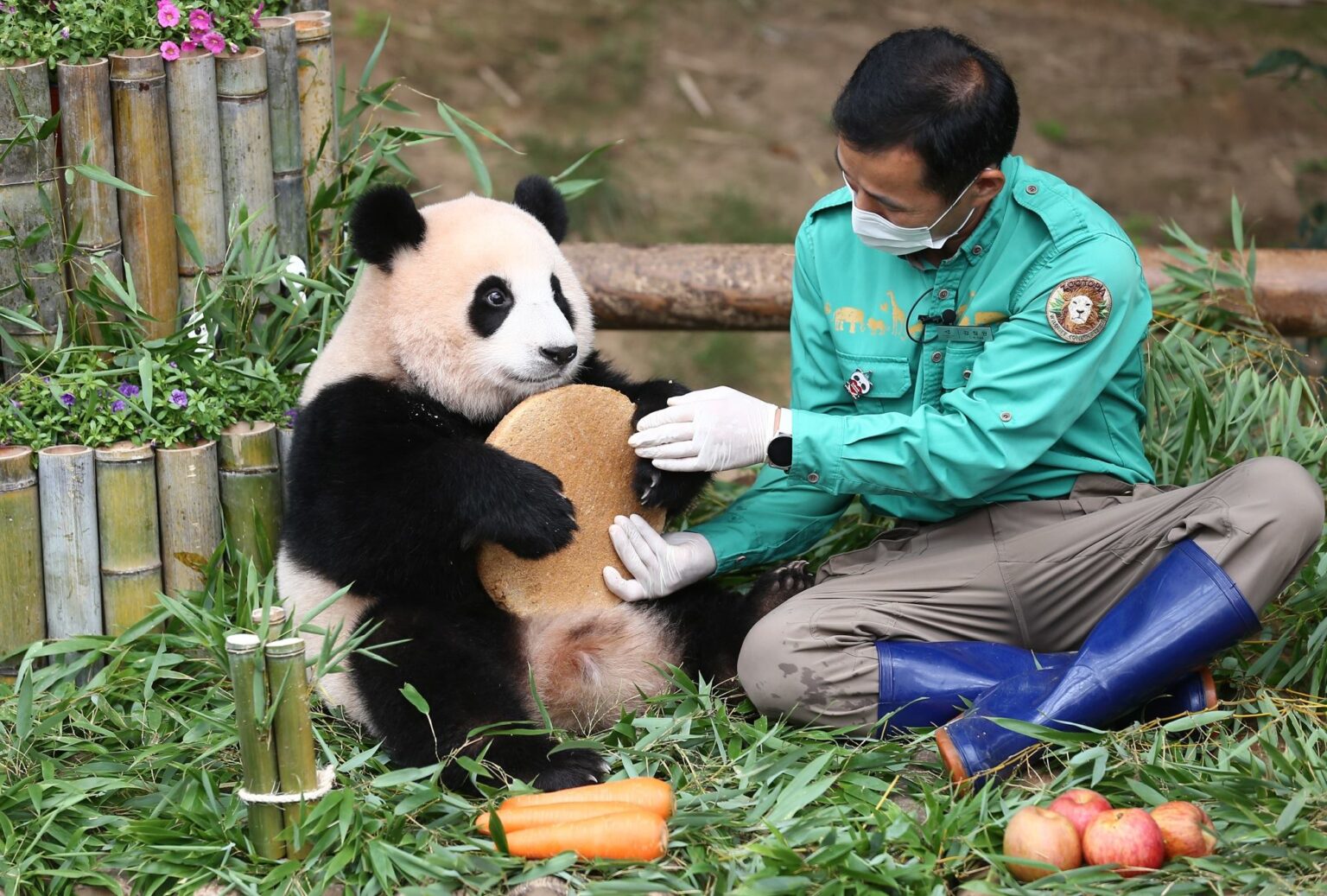
From the birth of Korea's first giant panda to a life among trees, vegetables, and memories. In an interview with keeper Kang Cheol-won, he shares his story of how he transformed care into a universal language..
Kang Cheol-won, for millions of people the “grandfather of Fu Bao”, is not only the guardian of Everland who accompanied South Korea's most beloved panda as she grew up. He is also the man who transformed a hillside garden into a life story, made of nature, family memories, patience, and daily work. His land in Yongin is home to dozens of trees and nearly ninety varieties of plants and crops: a small ecosystem where, he says, nature always gives back what it receives.
Kang Cheol-won, “Fu Bao’s Grandfather”: The Story
Kang Cheol-won's story begins a long time ago and isn't just about pandas. Before becoming the best-known face of giant panda care in Korea, Kang had already built a nearly four-decade career at Everland, also caring for monkeys, orangutans, and other difficult-to-manage animals. Over time, he developed a simple yet central belief: with animals, as with people, nothing is achieved without understanding, perseverance, and respect for each other's time.
Kang's public image is tied to Fu Bao, the first giant panda born in South Korea through natural reproduction, an event that attracted enormous attention in the country. But what stands out most in the interview is the human relationship he has built with the entire Bao family: Ai Bao, Le Bao, and the cubs born after them. For him, Fu Bao's popularity depends not only on the animal herself, but on the emotional involvement of those who have followed her day after day on social media, almost participating in a collective form of growth.
Kang's new book, "Every Morning I Go to the Garden,"“
Kang's new book, Every morning I go to the garden, was born from this very perspective. The garden is not just a pastime, but a place where childhood memories, affections, and long-pending desires converge. The gardener recounts that since he was young, he dreamed of a small house, with a green space to cultivate, where trees, flowers, and vegetables could coexist in harmony. That plot of land, initially discouraged even by those who considered it impractical, won him over at first sight. Not so much for its convenience, but for its resemblance to the landscape of his childhood in Sunchang, Jeonbuk Province.
Today, that garden has become a personal landscape, but also a place of healing. A sort of extension of the work done with the pandas, where each plant requires attention, time, and the ability to read the right signals. Kang recounts that it was there that she rediscovered gestures and habits tied to her mother, to the point of growing the same plants she kept in the family garden. That choice also sparked a more intense daily relationship with her mother, filled with phone calls, practical questions, and farming advice. A seemingly simple detail, in her voice, becomes a concrete form of filial gratitude.
Panda, bamboo and symbolic gestures
In his story, even the way the pandas are cared for is expressed through seemingly minimal details, yet with strong symbolic value. Kang explained that he planted bamboo, hardy trees, and even crops dedicated to the Bao family members, almost as if building a bridge between the pandas' world and that of the garden. The choice isn't aesthetic, but relational: to offer the animals a richer environment, closer to their natural language. Among the most significant episodes is the carrots prepared especially for Fu Bao and the other pandas.
However, the results don't always match human expectations. The first carrots were too small, then finally sturdy, but the pandas didn't always like them. Kang describes it with irony, as a useful lesson even outside the zoo. In nature, it's not enough to want to do well; you also need to understand the other's preferences, habits, and timing. A similar argument applies to the rapeseed flowers, planted in memory of the Chinese homelands of Ai Bao and Le Bao. The yellow blooms, which color the enclosure between late winter and early spring, aren't just for show: they're a gesture of welcome, a way to smooth the transition between different environments and cultures.
You may also be interested in:
Rui Bao e Hui Bao tornano in Cina a dicembre
AI e deepfake sui panda giganti
The connection with Fu Bao
The most delicate moment of the interview obviously concerns Fu Bao's departure for China, which occurred within the framework of international regulations governing pandas entrusted to foreign zoos. Kang speaks of the separation with a clarity that is not devoid of emotion: if an animal has been truly loved, he says, one must have the strength to accompany it even through separation, wishing it well to build its own adult life. His speech conveys not only nostalgia, but a clear vision of growth. Fu Bao wasn't just Korea's most beloved panda. She is a creature with a destiny all her own, to be nurtured with affection, never trying to restrain her.
In the interview, Kang Cheol-won returns to this concept several times, which almost becomes a lesson in sentimental education: respecting each other's time, leaving room for growth, learning to step aside when necessary. It's a principle that, in his story, applies to animals as well as human relationships. Kang directs the same gaze toward Ai Bao, Fu Bao's mother, whom he describes as a strong, intuitive, and deeply maternal panda. According to the keeper, Ai Bao protects her cubs naturally, without excess or force: she observes, waits, and intervenes only when necessary. A discreet yet effective form of care, which Kang cites as an example of parenting capable of combining presence and autonomy.
A philosophy of care
The interview reveals a very clear trait of Kang's personality. For him, caring is never an abstract gesture. It means recognizing the behavior of each species, respecting its fears, knowing its intelligence, and never forcing the relationship. In his years working with primates and big cats, he has learned that trust is built through constant presence. In some cases, as he explains, even sleeping near the animals was necessary to gain acceptance into the group. This experience leads him to a very clear conclusion: violent behavior leaves lasting scars that are difficult to erase, while patience and observation open unexpected avenues. The same logic, he believes, applies to the family, in raising children, and in the relationship with the plant world. It's a simple philosophy, but one expressed with such coherence that it becomes convincing.
It's no surprise, then, that the public found consolation in his words. Fu Bao's popularity transcended the simple affection for a cub. In Korea, the panda has become a shared emotional presence, capable of accompanying people who are lonely, fragile, or in difficulty. Kang never claims a heroic role; he simply says that if an animal can make someone feel better, then the keeper's work has already produced a valuable result. This is not just the story of a keeper, but of someone who has transformed his profession into a form of relationship. And precisely for this reason, Kang-Cheol-won's story remains simple and powerful: with animals, with plants, and with people, trust is built when you know how to wait.