






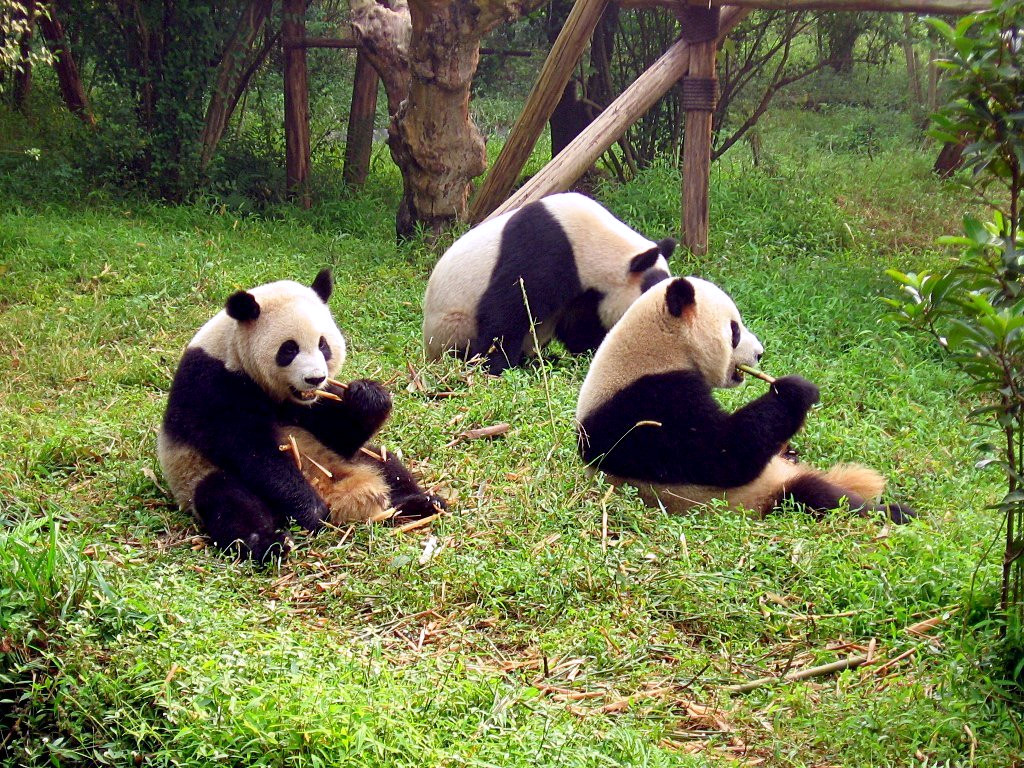
Classified as carnivores but almost entirely herbivorous, giant pandas live on bamboo, They rarely eat small prey or carrion, and in captivity they don't eat fish. This is why their biology has distanced them from animal protein.
What does the giant panda eat besides bamboo?
Do pandas eat fish? The short answer is no. In the wild and in captivity, the giant panda does not hunt aquatic prey and does not include fish in its diet. usual diet. Although it belongs to the order of carnivores, over millions of years it has specialized almost exclusively on bamboo, which today represents approximately 99% of the food consumed in nature, with dozens of different species and up to tens of kilos of shoots and leaves consumed daily. Only on rare occasions does it feed opportunistically on small animals, eggs, or carrion, but these are sporadic episodes that do not alter its nature as an "atypical herbivore.".
Why the panda doesn't need fish
The giant panda's ancestor was likely omnivorous and also consumed meat, but the combination of the extinction of many prey species and the abundance of bamboo in China pushed the species toward a highly specialized plant-based diet. Genetic and physiological studies show that the panda retained a carnivorous digestive system but developed specific adaptations—such as mechanisms to detoxify bamboo cyanides and a very low metabolism—that allowed it to survive on a low-energy diet.
This specialization makes its organism "programmed" to seek out bamboo rather than animal protein. The microRNAs present in the plant even influence taste, smell, and reward pathways, pushing the panda to increasingly find bamboo more palatable than other food sources. In this scenario, introducing fish would offer no real nutritional benefit and is not part of the animal's natural instincts, unlike brown and polar bears, which habitually hunt fish and other vertebrates.
What do pandas eat in the wild?
In the wild, the giant panda spends much of its day foraging for and eating bamboo, selecting different species depending on the season to balance the most nutrient-rich leaves, stems, and shoots. Protein and mineral intake varies with location or altitude, but remains dependent on the plants, not the systematic hunting of animal prey.
Field observations document that, in rare cases, pandas may consume small mammals, eggs, insects, or carcasses, events considered opportunistic and not part of a structured feeding strategy. However, there are no solid reports of active fishing: the panda can swim, but it lacks the techniques or evolutionary motivations that characterize piscivorous species like the brown bear during salmon migration periods.
Panda Diet in Captivity: Why Fish Is Not Used
In research centers and zoos, nutritionists try to mimic the natural diet as closely as possible: large quantities of fresh bamboo are supplemented with fruits, vegetables, pellets, or "panda biscuits" formulated to provide missing proteins, vitamins, and minerals. These supplemental foods are calibrated to support growth, reproduction, and health without disrupting the animal's intestinal ecosystem.
Fish isn't normally included in these feeding plans because pandas haven't developed behavioral strategies for fishing, and their digestive systems are already highly adapted to handle enormous quantities of bamboo fiber. Regularly introducing animal proteins like fish would go against the logic of reproducing a diet consistent with the evolution of the species and could generate nutritional or digestive imbalances.
The diet: no fish, lots of bamboo
To the question "Do pandas eat fish?" the answer is that the giant panda is a former carnivore that has become almost entirely herbivorous. It lives on bamboo, rarely includes small terrestrial prey, and does not include fish either in the wild or in menus studied in captivity. Understanding this transformation helps dispel the myth of the "panda bear like the others" and tells one of the most fascinating evolutionary stories in the animal world, perfect for informative, educational, and search-optimized content.