






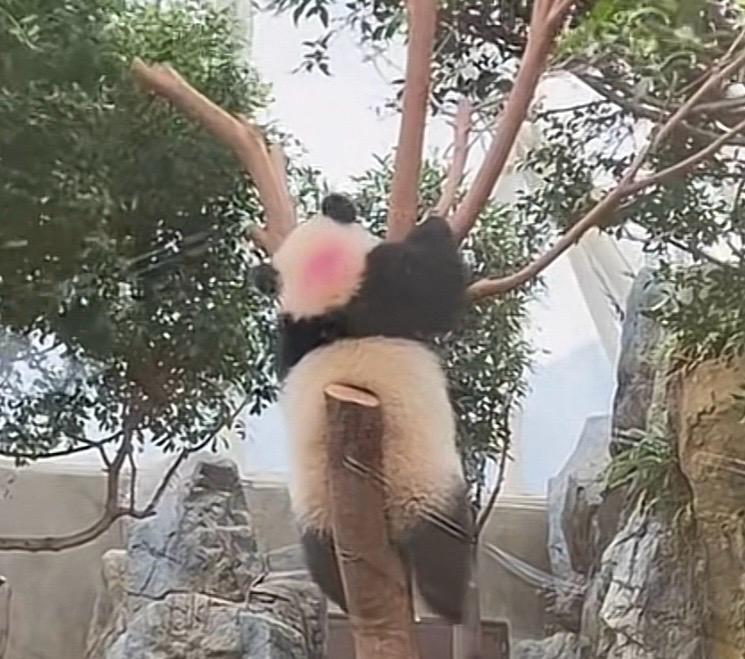
The phenomenon of pink or reddish spots on the fur of giant pandas, like the one evident on the panda's back in the photo, fascinates and worries those who watch videos on social media. These are not injuries or health problems, but a natural process linked to the biology of their iconic coat.
Pink spots on the giant panda's back: the reasons
Scrolling through social media, you might come across a giant panda climbing a tree, or playing with a bright pink spot that stands out against its pure white fur and characteristic black spots. That's exactly what your photo shows: a young panda, active and calm, with a clearly visible mark that immediately catches your eye as it climbs the tree. It's not a wound or a sign of illness, but a completely natural phenomenon. A biological detail that contributes to making these animals even more fascinating. This article clearly and thoroughly explains what these pink (or reddish) spots on the backs of giant pandas are. Why they appear, in what situations they are most common, how they form chemically, and in which rare cases they might indicate something else. It answers the most common online questions and offers information to those who love these animals.
How a pink stain is formed: saliva, the real culprit
Let's start from the beginning. The giant panda's white fur is not only beautiful, it's also extremely porous and sensitive. When a panda licks itself—and it does so often, like a cat calling—its saliva comes into contact with that white fur. Saliva contains enzymes like peroxidase and amylase, natural substances that, when exposed to oxygen and moisture, trigger a chemical oxidation reaction. The result? The fur turns pink or reddish, superficial and temporary. In the photo, the spot on the back is a perfect example. That area is less dense than other parts of the body, so it absorbs pigments more easily. The panda may have wet it while self-licking, perhaps to clean itself after a bamboo meal or a moment's rest. Or, if it's a cub or a young panda, it could be maternal saliva. Mothers lick their cubs dozens of times a day to stimulate digestion and cleanliness, depositing it right there, on the accessible back. Humidity—think of the fog in the pens of Shenshuping or Chengdu—accelerates the process, making the stain visible and clear as soon as you capture it. This isn't an isolated case. The pink color appears, dominates for hours or days, then fades with natural washing or shedding. It's the same principle that turns the fur of white dogs pink around their eyes or paws: porphyrins and enzymes at work, harmless and physiological.
Why exactly on the back? Anatomy tells the story.
It's no coincidence that the spot is concentrated there. The panda's back is a strategic area. It can be reached by the tongue when calling, often rubbed against branches or rocks in enclosures decorated with artificial trees. The fur on the back is thinner and lacks the protective dark pigments of the ears or shoulders, so it stains easily. In cubs, it's even more common. The mother, in fact, licks them primarily on the back and sides to keep them clean and stimulate circulation. They grow with that temporary pink color, which fades around 2-4 months as the fur thickens. In adults, urine marking also comes into play. Pandas use urine to communicate status and territory, and residues containing porphyrins (red compounds) can deposit on their rear ends during rest. But in the attached photo, there's no trace of dirt or inflammation; it's clean, even, a classic salivary mark.
You may also be interested in:
RouRou in difficoltà: le sue condizioni di salute
Puppies, adults, and seasonality: the contexts in which you see them most
Watching years of live feeds from panda bases like Wolong and Bifengxia, a clear pattern emerges. In cubs under six months old, pinkness on the back is almost the norm: pinkish underlying skin + maternal saliva = a "powder panda" effect. Viral videos from Chengdu are full of it, and keepers explain it in the comments to reassure the public. In adults or young ones—as this agile and robust specimen appears—it's related to daily grooming. Pandas spend hours licking themselves, especially after meals (fibrous bamboo leaves residue). In summer, with higher humidity, the spots persist longer. Rarely, a slight contribution comes from environmental factors: red soil from Qinling or substrates in enclosures. But no, it's not a bruise—the wounds show swelling, missing fur, or scabs, which are absent here.
| Context | Typical age | Dominant cause | Average duration |
|---|---|---|---|
| Daily grooming | Adults/Youth | Oxidized saliva | 1-3 days |
| Maternal care | Puppies | Saliva + pink skin | 1-3 months |
| Urine/environment | Everyone | Porphyrins + wet | Hours-days |
When to worry? Pathological exceptions (rare)
The vast majority of pink spots are completely harmless, but it's important to consider less common cases as well. When the coloration is accompanied by persistent itching, hair loss, or lethargy, it could be a sign of fungal dermatitis—more common in humid captive environments—or prolonged stress affecting hair follicles. Some documented cases, such as those observed in Chengdu in 2018, showed a combination of redness and alopecia related to fungal infections (e.g., the genus Mucor), which were then resolved with antifungal treatments. In the case of the image, however, no such signs emerge. The fur appears intact, the posture is relaxed, and the environment is natural. In doubtful situations, veterinarians resort to specific tests such as skin biopsies or hair cortisol analysis to distinguish between physiological and pathological causes. Here, however, everything points to a simple effect related to normal seduction activity.
In the centers: how they prevent and monitor
At the Shenshuping and Dujiangyan centers, very precise protocols are adopted: efficient drainage systems, saline baths, and long-term photographic monitoring. Nutrition also plays an important role. A varied diet helps reduce the presence of more pigmented urine. The results are evident. The panda is healthy, with minimal spots, and visitors are more aware. Those pink hues on its back are not defects, but traces of natural behavior. They speak of an animal that takes care of itself and maintains its balance. When you notice them, it's worth looking at them with different eyes. They are, in a certain sense, a signature of the giant panda.