






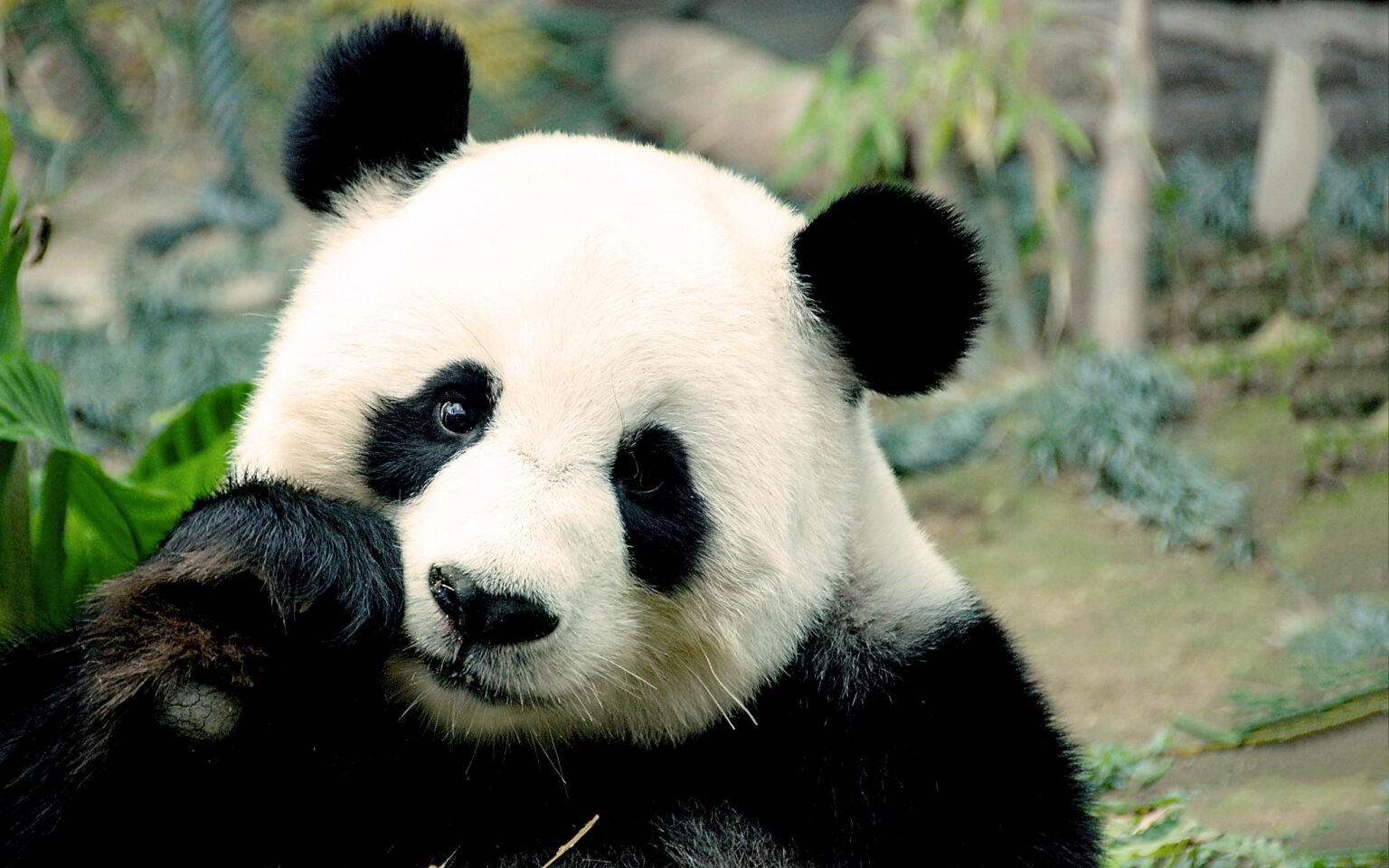
Giant pandas are mammals essentially solitary, both in the wild and in well-managed zoos. Only during the short mating season Males come into close contact with females. For the rest of the year, each occupies its own individual territory, delimited by odors and markings. This lifestyle strongly influences how they relate to females and puppies. The male panda, in most cases, he doesn't “live with his wife” nor with children, even when they live in the same park or sanctuary.
Why the male panda lives alone and not with his wife and children: natural tendency towards solitude
The giant panda is genetically predisposed to solitary life, similar to many other bears but more marked. In natural territories the home range Males may partially overlap, but in practice each individual avoids direct contact unless there are females in estrus or limited resources. In captivity, this characteristic is maintained. Zoologists tend to do not cohabit permanently male, female and puppies, precisely because it could generate stress and conflicts.
Management of territory and competition
Males mark their territory with urine, anogenital secretions and scratches on trees, creating actual "marking stations" that other pandas read by smell. This system reduces the need for direct confrontations and allows more individuals to coexist. without the formation of permanent family units.
Reproductive dynamics that lasts a few days
The fertile period of the female panda It's extremely short: only 1–3 days a year. Most males in nature wait years before mating. In captivity, they are only allowed to meet for this brief period, after which they are separated again or kept in separate areas. For these reasons, the relationship between male panda and cub is almost always limited to genetic exchange, not to a lasting coexistence.
Male, female, and puppies: who lives with whom?
There mother panda is the only parent present in the daily care of the puppies. The little ones stay with their mother for 1.5–3 years. A period during which they learn to feed on bamboo, to move around the territory and to develop survival strategies. During this period, the male plays no role in breeding behaviors. Sometimes he doesn't even recognize which are his children, even in captivity.
The male prefers independence
Why does the male panda live isolated from his wife and children? In wildlife, Young males leave their mother at the age of 2–3 years and move to new areas, "conquering" new territories. The "panda family" model with mother, children, and father alongside is almost always a human invention. Documentaries and zoo photos tend to misrepresent this relationship, but biologically the male is more of a “temporary visitor” than a cohabiting parent.
What's the difference between nature and captivity: the role of the male?
In nature
In protected areas such as the Foping National Nature Reserve In China, researchers observed that adult pandas maintain solitary behaviors but with an indirect social network based on odors and markings. THE adult males, however, are the most socially active. They are the ones who interact with the most individuals in the area, even without forming stable groups.
In zoos and conservation centers
The management of pandas in international zoos (China, United States, Europe) favors an approach that respects the natural needs of solitude and territoriality, to reduce stress and increase the chances of reproduction. Often, before mating Males are temporarily introduced into the female's area. At the end of the fertile period they are withdrawn, leaving the female and future puppies manage the space without male interference. Several studies on panda twins have shown that the Puppies show no behavioral advantage if the “dad” is present, confirming that in this context paternal presence is not evolutionarily selected.
Why the male panda does not participate in the care
Despite the number of hours spent observing pandas, the male libido is relatively low, especially in captivity.In a year, males mate at most 24–72 hours, a window of a few days that does not justify a continuous parental commitment as in the case of social mammals.
Selectivity and competition between males
During courtship, several females and males may be involved in multiple “courtship trials”. Multiple males chase the same female in estrus, which has the ability to choose its partner. In this scenario, the evolutionary advantage is for the male who reaches fertilization, not for what remains of the destructible territory or resources in the care service.
Fragile nestlings but self-sufficient for the male
Panda cubs are born very weak, weighing just a few grams and extremely dependent on the mother. Furthermore, the male's role does not include the possibility of breastfeeding or continuously holding the baby, so it would be little practical difference if he stayed with the female.
How zoologists manage panda pairs
After the short period of contact between male and female, breeding program operators usually:
- They physically separate the two specimens;
- they monitor the female's pregnancy in isolation by promoting a calm environment;
- They prepare specific spaces for the birth and first months of the puppies, minimizing the number of interactions with strange males.
Assisted reproduction and the “alone” panda”
In many conservation centers, programs of artificial insemination They are now well-established, and the male does not need to live continuously with the female to produce healthy offspring. In these cases, the male panda can continue to live in a separate enclosure, even for years, without ever actually meeting his “wife”, while still contributing genetically to the species.
Single but socially active male panda
Even though he lives alone, the male panda it is not a completely unemotional animal. He communicates with other individuals through body language and odors. In the presence of females in heat, he can emit particular songs and vocalizations, signals that can be heard very well in dedicated sanctuaries and parks. In nature, an adult male's social network may include different individuals “known” through smells and markings, but this commonality never translates into a family cohabitation like that of humans or primates.
The synthesis explained in a few steps
- The giant panda is genetically solitary, both in the male and female sex.
- The male does not need to live with the female and her cubs. His biological task is limited to a short annual window.
- Modern zoos they respect this individual lifestyle pattern, separating males to reduce stress and maximize reproductive success.
In reality, the “single panda” who lives alone is the perfect result of millions of years of evolution, not a sentimental choice or a behavioral flaw.